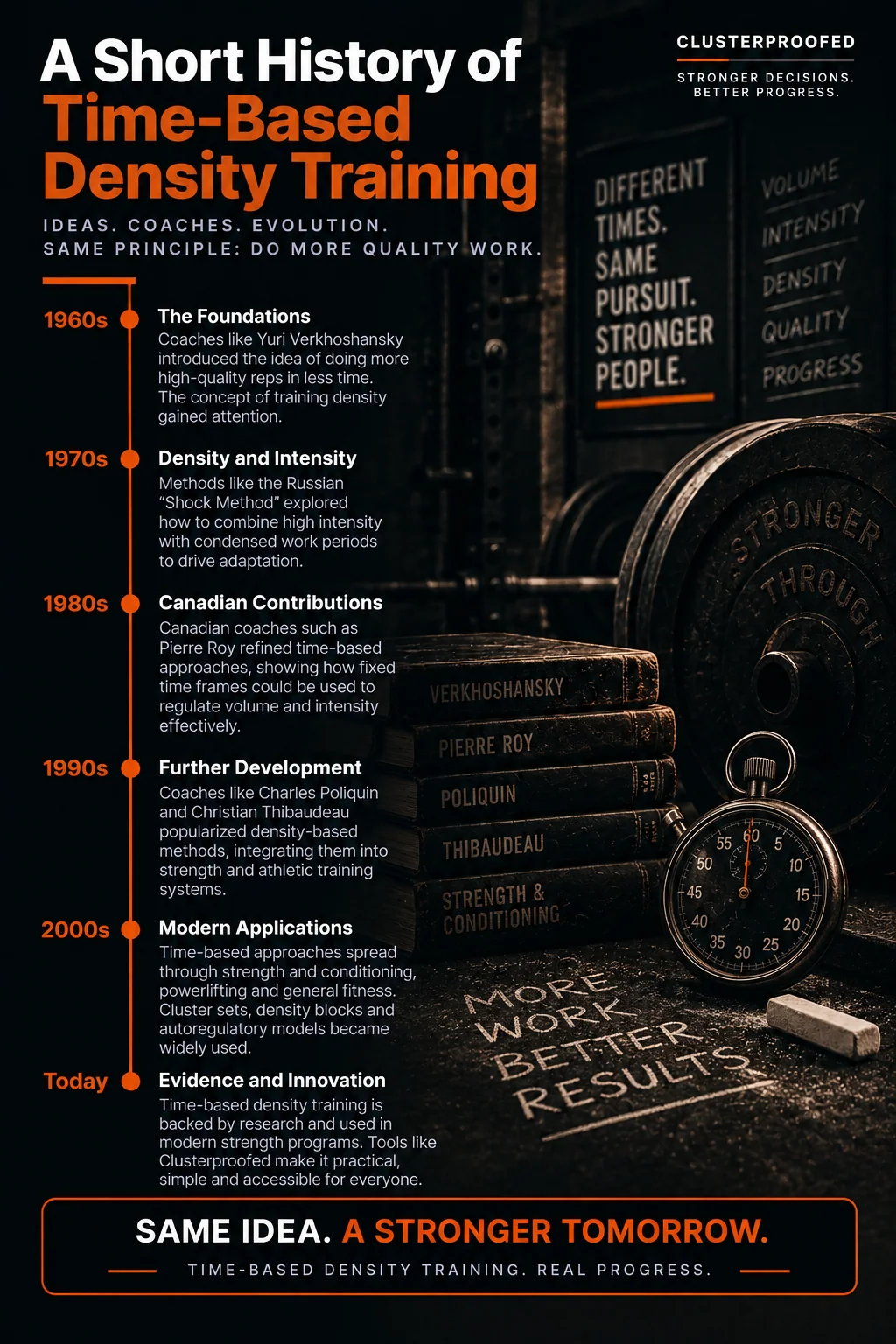
Time-Based Density Training sounds like a fairly modern idea.
Stopwatch, training app, digital training data – it would be easy to assume that the idea of organizing training around a fixed time window only emerged with the modern fitness world.
In fact, its roots go back considerably further.
There is no single inventor, and no specific year in which Time-Based Density Training was suddenly "invented." Rather, various training approaches developed over decades, all grappling with a similar question:
How can you do as much high-quality training work as possible within a limited time, without fatigue prematurely limiting performance?
One particularly interesting part of this story doesn't lead into a modern gym, but into the world of Olympic weightlifting.
An Unusual Approach from Egypt
One of the older stories that keeps coming up in connection with time-based training leads to Egyptian weightlifters in the mid-20th century.
According to later accounts, they worked with a simple but unusual principle: a specific time window was set for an exercise. Within that window, athletes were meant to repeatedly perform small sets with a fixed load.
It wasn't a particular number of sets that was the decisive criterion.
It was time.
A typical scheme, as later passed down by coaches, might allot 20 minutes for the main lift, 15 minutes for a secondary lift, and shorter windows for supplementary work. The rep ranges used could vary depending on the goal – single reps for strength, triples for a heavier working form, or higher rep counts for more volume.
An important historical caveat: the name "Egyptian Routine" and many details of this approach are known mainly through later reports and coaching lore. A modern, scientifically documented original source from 1950s Egyptian weightlifting that clearly establishes the system described today as a unified method is hard to pin down.
The idea itself is remarkable nonetheless.
Because it already contains a thought that is central to modern Time-Based Density Training:
Time isn't just measured. It defines the frame within which performance is meant to happen.
Pierre Roy and Canadian Weightlifting
The story gets particularly interesting a few decades later in Canada.
The Canadian weightlifting coach Pierre Roy adopted elements of such a time-based approach and integrated them into his training work.
Roy was a national coach in Canadian weightlifting and worked, among others, with Jacques Demers, who won silver at the 1984 Olympics. Other top Canadian athletes, such as Denis Garon, were also trained by him. His significance for Canadian weightlifting is well documented; Canadian weightlifting history explicitly lists Roy as a coach of the national team at the time.
The time-based structuring of training became a defining element of his work.
Strength coach Christian Thibaudeau, who trained under Pierre Roy himself, later described how Roy set fixed time limits for individual exercises. Within that time span, athletes repeatedly performed small sets with a defined load. Thibaudeau reported that this principle was already used among Canadian weightlifters before he later developed it further for his own training systems.
This is where the story becomes especially interesting.
Because Roy's approach wasn't simply "as much training as possible in as little time as possible."
The quality of the reps played a central role.
Thibaudeau described, for example, a system in which athletes tried to complete as many clean sets as possible within a time window. A technically poor or noticeably slower rep was treated as a warning sign. If performance couldn't be restored even with an extra rest, the exercise was ended.
That sounds remarkably modern.
The Canadian Idea: Time as a Boundary, Not an Opponent
This changes the meaning of the clock.
It doesn't say:
You have to train faster now.
It says:
You have a defined time window for this task.
Within that frame, the athlete can organize their performance.
A heavy set isn't simply pushed to maximum fatigue. Instead, smaller work blocks are used. Rest periods are chosen so that the next high-quality rep becomes possible.
That's an important distinction.
The clock doesn't necessarily force more speed.
It creates a boundary within which performance has to happen.
This exact idea reappears later in various forms of density training.
From Weightlifting to Escalating Density Training
A second important station in this development is Charles Staley.
In the early 2000s, Staley popularized a concept he called Escalating Density Training, or EDT for short, in which a certain time span is set and the athlete tries to do as much work as possible within that window.
This turned training density itself into a progression parameter.
Say an athlete completes 30 total reps with a certain load in 15 minutes.
At the next session, they try to reach 32 or 34 reps under comparable conditions.
The weight doesn't need to change for that.
The time stays the same too.
What changes is the performance produced within that time window.
Staley made this idea accessible to a much wider audience and coined the term Escalating Density Training in the process.
That gave the idea a name and a clearer training logic.
Two Different Paths Meet
Historically, it's interesting that two lines of development meet here.
On one side stands the cluster principle.
Reps are broken into smaller groups to control fatigue within the working phase.
On the other side stands the density principle.
Training work is related to a defined time window.
One answers mainly the question:
How do I organize my reps?
The other:
How much work can I do within a certain time?
Time-Based Density Training combines these two ideas.
Science Catches Up with What Practice Had Already Been Trying
It's interesting that many of these training ideas originally came from practice.
Coaches observed that athletes could produce certain performances better when they didn't push every set to maximum fatigue.
Only later was what was actually happening increasingly studied scientifically.
Research on cluster sets shows, for example, that short intra-set rest periods can reduce the drop in movement velocity and power output. This allows more reps to be performed at high intensities with relatively high mechanical and technical quality. That doesn't automatically mean clusters are superior to every traditional set scheme in the long run. But it does show that how work and rest are distributed within a set has a measurable effect on acute training performance.
That gives an old practical observation a scientific explanation:
How we distribute work affects what we're able to produce.
From Reps to Training Density
This also shifts the view on training volume.
Traditionally, volume is often seen simply as the number of sets and reps.
That's reasonable, but incomplete.
Because ten reps can happen in five minutes or in twenty minutes.
The work is the same.
The conditions are not.
This is exactly where training density comes in.
In simple terms, it describes the ratio of work performed to the time it took.
That turns time into an additional dimension of training control.
And suddenly, progress can be viewed differently.
Not just:
More weight.
But also:
More high-quality work in the same time.
Time-Based Density Training Is Therefore Not a Completely New Invention
This is perhaps the most important historical takeaway.
Time-Based Density Training doesn't stand outside existing training science.
It's more of an intersection of different ideas.
From classic strength training comes the importance of load and relative intensity.
From cluster training comes the structured distribution of reps and rest.
From time-based weightlifting approaches comes the idea of a fixed work window.
From modern density training comes the notion of using work per unit of time as a progression metric.
And from today's training science come concepts like autoregulation, movement velocity, and fatigue management.
The result isn't a completely new training principle.
It's a further development.
From Roy to Density8
This is exactly where the modern interpretation begins.
A time-based training system can be structured far more precisely today than it could a few decades ago.
Intensity can be defined.
Cluster size can be adjusted.
The time window can be set.
Technical criteria can determine which rep actually counts.
And the performance produced within that frame can be documented and compared across multiple sessions.
A stopwatch thus becomes a control instrument.
Not because the clock itself trains.
But because it sets a clear boundary within which the athlete can demonstrate their current level of performance.
The Idea Is Older Than the Technology
That's perhaps the nicest part of this story.
You don't need an app to understand Time-Based Density Training.
Pierre Roy didn't need one.
The weightlifters didn't need one.
Charles Staley didn't need a modern training app for EDT either.
What has changed is the ability to structure, document, and connect these ideas more precisely.
The basic idea remains remarkably simple:
Define the load. Define the time. Structure the reps. Control the fatigue. And observe what is actually achieved within this frame.
Maybe Time-Based Density Training is therefore less a new invention than an old idea that can now be understood more precisely.
The clock was always there.
We've just started treating it as a training variable.
Sources & Further Reading
The sources were chosen to match the article's central claims. They are meant to make the factual statements traceable; the strength of the evidence varies by topic.
- Staley, C. (2002), "Escalating Density Training," T-Nation.
- Staley, C. (2005), Muscle Logic: Escalating Density Training, Rodale.
- Form Is Everything (2020), "Beyond Sets and Reps: Density Training (Including an Interview With Its Developer)." https://formiseverything.com/2020/09/19/beyond-sets-and-reps-density-training-including-an-interview-with-its-developer/
- Latella, C. et al. (2019), Sports Medicine 49, 1861–1877, "The Acute Neuromuscular Responses to Cluster Set Resistance Training: A Systematic Review and Meta-Analysis." PMC6851217
Historical note: Statements about early Egyptian weightlifters and about Pierre Roy's training method rest on later accounts and coaching tradition (among others by Christian Thibaudeau) and are not equivalent to modern peer-reviewed research. For the documented origin of EDT, Charles Staley's own publication is the more reliable primary source.
Important: The sources do not automatically support every specific program prescription in Clusterproofed. Time windows, cluster sizes, and percentage-based loads are training-design decisions of the system and should be understood as such.