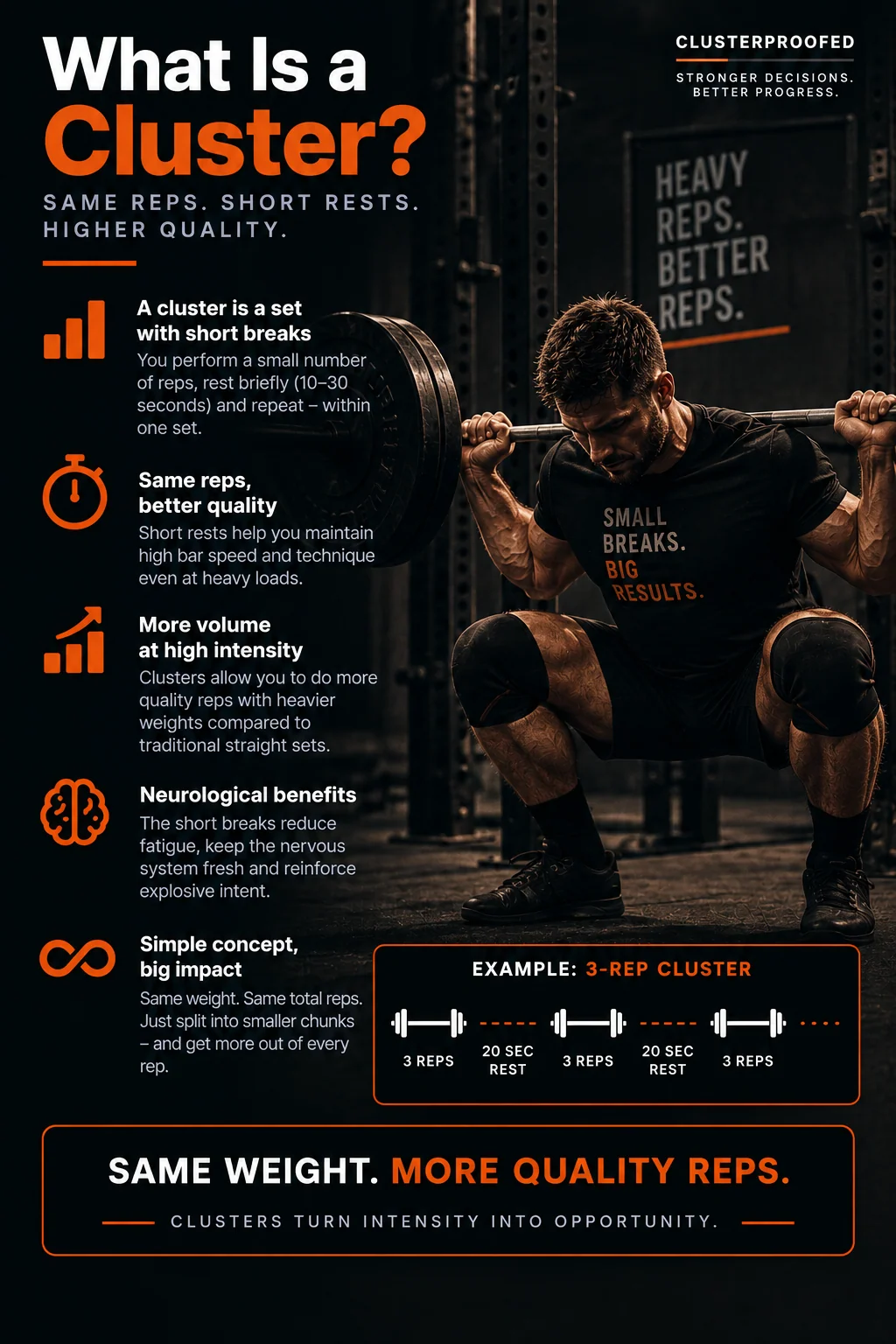
The term "cluster" has become fairly common in strength training. It's often used simply to describe a group of reps broken up by short rests.
That's not wrong – but it's not a particularly good definition either.
Because there's more behind a cluster than the idea of catching your breath briefly between two reps. It's about organizing load differently: the reps of a set are no longer necessarily performed in one continuous block, but broken down into smaller units.
The goal behind this is, above all, one thing: controlling fatigue without unnecessarily reducing the training load.
A Set Doesn't Have to Happen in One Block
Take a classic set of six reps:
6 reps → rest
That's the familiar structure.
A cluster might turn this into, for example:
2 reps → short rest → 2 reps → short rest → 2 reps → longer rest
On paper, six reps were still performed.
Physiologically and practically, though, the load isn't identical.
The short rests within the cluster give the athlete a chance to shed some of the acute fatigue before the next small group of reps begins.
The rests aren't merely recovery between sets, then. They become part of the set structure itself.
Why Would You Split Up Reps at All?
The answer lies in fatigue.
With several consecutive reps, local and systemic fatigue rises. At the same time, the ability to produce high force and power changes. Especially at high loads, even a few reps can cause bar speed to drop noticeably.
That's one reason heavy sets become increasingly demanding as the rep count climbs.
A cluster addresses exactly this.
The brief interruption reduces fatigue within the series. As a result, the next group of reps can often be performed with higher movement velocity and better technical quality than would be possible in one continuous series.
That doesn't mean the fatigue disappears.
It's simply distributed differently.
Clusters Are Not Just "More Rest"
That's an important distinction.
If there are five minutes of rest between every set, that doesn't automatically make it cluster training.
The special feature of a cluster is that the rest happens within an otherwise connected rep structure.
Put simply:
A classic set organizes its reps as one connected block.
A cluster breaks that block into smaller units.
For example:
Classic
5 × 5
Cluster
5 × (2 + 2 + 1)
The total number of reps can stay the same. What changes is how these reps are distributed.
And it's exactly this distribution that affects the load.
Clusters Can Look Different
There's no single "the" cluster.
The size of the individual sub-groups and the length of the rests can be chosen differently.
A triple cluster might look like this:
3 → rest → 3 → rest → 3
A double cluster:
2 → rest → 2 → rest → 2
Or, at very high intensities:
1 → rest → 1 → rest → 1
At heavy loads in particular, singles can be interesting, because each rep is executed relatively isolated from the fatigue of the one immediately before it.
The smaller the cluster size, the more tightly fatigue within the series can be controlled.
That doesn't mean smaller clusters are fundamentally better, though.
The right structure depends on the goal, the load intensity, and the exercise.
What Happens to Performance?
This is one of the most interesting aspects of cluster training.
In classic sets, fatigue rises rep by rep. Movement velocity often drops accordingly.
With clusters, part of this trajectory can repeatedly be interrupted.
After a short rest, the athlete is often able to perform another high-quality rep.
That can be particularly interesting at high loads.
Someone training at 85–90 percent of their 1RM can't perform an unlimited number of reps in a row at high velocity and clean technique. Through clusters, the total work can still be organized so that several qualitatively high reps at a relatively high load become possible.
Cluster training can thus form a bridge between high intensity and controlled fatigue.
The Decisive Point: Quality Over Sheer Rep Count
A cluster isn't automatically successful just because a lot of reps end up on the training log.
Especially with heavy exercises, rep quality should play a decisive role.
If technique clearly breaks down, if movement velocity drops sharply, or if the intended movement can no longer be performed under control, another rep isn't necessarily a productive rep.
This is especially relevant for a time-based system.
If, for example, several clusters are completed within a defined time window, the clock must not become the sole goal.
Time defines the frame. Quality determines what counts within that frame.
Clusters and Classic Sets Don't Pursue the Same Goal
That doesn't mean classic sets are outdated.
A set of eight or ten connected reps produces a different kind of fatigue than several smaller clusters. That fatigue can be entirely desirable for certain training goals.
Clusters, therefore, aren't a replacement for regular sets.
They're a different way of organizing reps.
They become particularly interesting where high mechanical tension, technical quality, and fatigue control all matter at the same time.
That can play a significant role in strength training at high intensities.
Clusters in Time-Based Density Training
In Time-Based Density Training, the principle takes on yet another function.
Here, it's not only defined how many reps are performed, but also how much time is available for them.
An example:
15 minutes 80% 1RM 3 reps per cluster
The number of clusters isn't necessarily fixed in advance.
The athlete works within the time window and tries to complete as many technically high-quality clusters as possible.
This connects three important variables:
Intensity – cluster size – time.
The cluster structure controls fatigue within the work. The time window limits the total load. Intensity determines how heavy each rep is.
This combination produces a training stimulus that differs from a classic set scheme.
What a Cluster Ultimately Is
A workable definition might therefore be:
A cluster is a structured group of reps that is broken into smaller sub-groups through short intra-set rests, in order to control fatigue within the series and keep the quality of individual reps as high as possible.
The decisive factor, then, isn't the short rest by itself.
It's the deliberate distribution of the reps.
A cluster doesn't necessarily change the total number of reps or the weight used. It changes the conditions under which those reps take place.
And that's exactly where its strength lies.
Sometimes the best way to produce more high-quality work isn't to force another rep.
It's to stop for a moment first.
Sources & Further Reading
The sources were chosen to match the article's central claims. They are meant to make the factual statements traceable; the strength of the evidence varies by topic.
- Tufano, J. J., Brown, L. E. & Haff, G. G. (2017), Journal of Strength and Conditioning Research 31(3), 848–867, "Theoretical and Practical Aspects of Different Cluster Set Structures: A Systematic Review." DOI: 10.1519/JSC.0000000000001581
- Latella, C. et al. (2019), Sports Medicine 49, 1861–1877, "The Acute Neuromuscular Responses to Cluster Set Resistance Training: A Systematic Review and Meta-Analysis." PMC6851217
- Davies, T. B. et al. (2021), Sports Medicine, "Chronic Effects of Altering Resistance Training Set Configurations Using Cluster Sets: A Systematic Review and Meta-Analysis." DOI: 10.1007/s40279-020-01408-3
Important: The sources do not automatically support every specific program prescription in Clusterproofed. Time windows, cluster sizes, and percentage-based loads are training-design decisions of the system and should be understood as such.