More weight on the bar.
That's probably the best-known idea of progression in strength training.
Last week, 80 kg.
This week, 82.5 kg.
Next week, 85 kg.
Done.
The problem:
Progression is bigger than a weight plate.
And anyone who views training exclusively through the lens of rising weight overlooks a large part of what actually constitutes progress in strength training.
What Does Progressive Overload Mean?
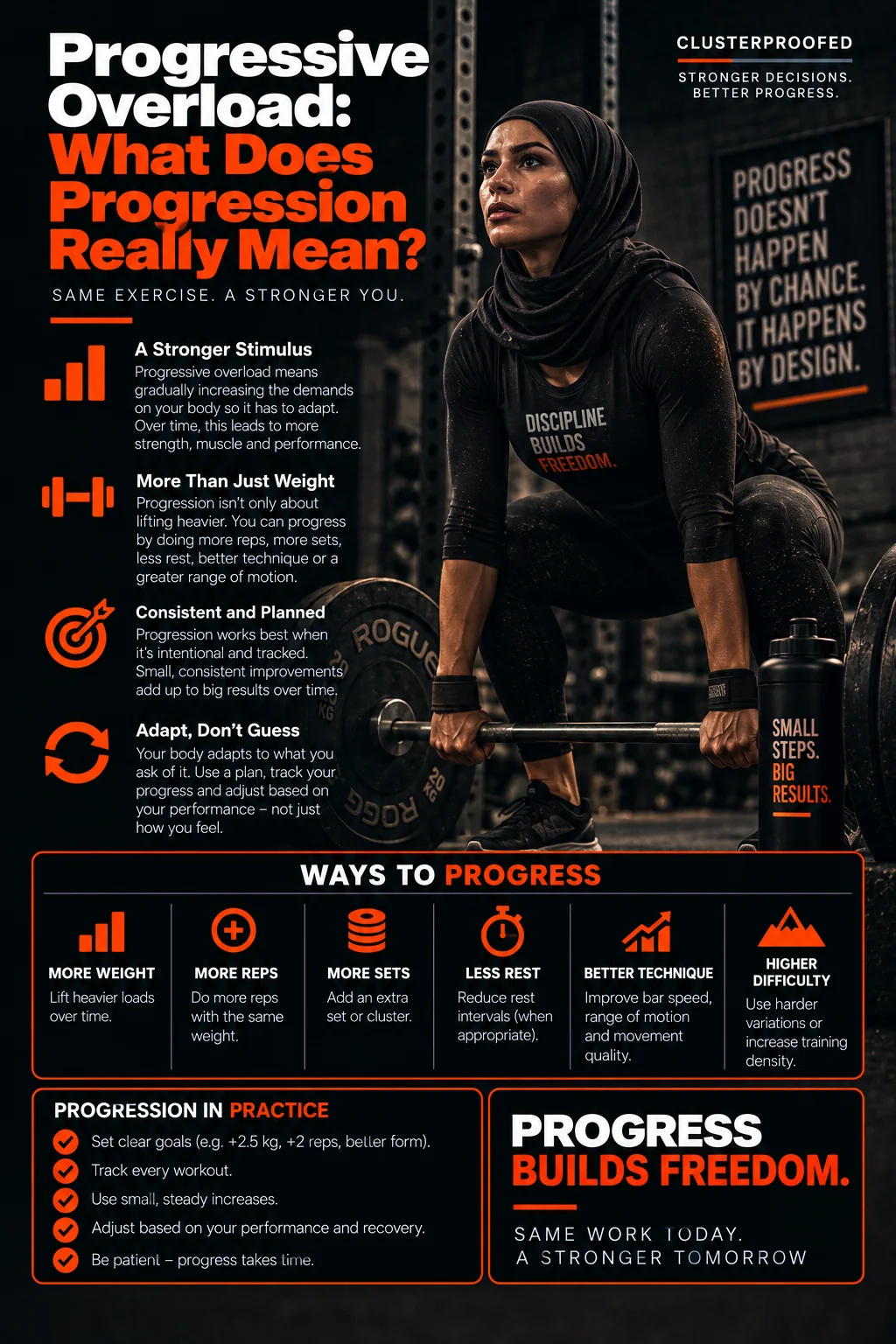
Progressive overload, in simple terms, means that the training stimulus is adjusted over time so the body continues to have a sufficient reason to adapt.
That can mean:
more weight.
But also:
- more reps
- more sets
- better technical quality
- higher training density
- higher movement velocity at the same load
- more performance within a time window
- the same performance at lower perceived effort
Progression, then, is not identical to:
"more weight every week."
Why Does This Even Work?
The body adapts to recurring loads.
A weight that was very heavy six months ago can be considerably lighter today.
A set that used to require five reps to create a high load can eventually become less demanding.
If the training stimulus stays permanently unchanged, further adaptation may eventually slow down.
That's why training has to change over the long term.
But:
Change doesn't necessarily mean maximization.
More Weight Is Just One Form of Progression
Take the bench press.
Week 1:
80 kg × 8
Week 6:
85 kg × 8
That's obviously progression.
But take a different development:
Week 1:
80 kg × 6
Week 6:
80 kg × 10
That's progression too.
Or:
Week 1:
80 kg – 10 reps in 12 minutes
Week 6:
80 kg – 14 reps in 12 minutes
Again, a performance increase.
The weight hasn't changed at all.
And yet the athlete has become more capable.
Progression Can Happen Within a Time Window
This is particularly interesting for time-based training.
Imagine you train for 15 minutes at a certain load and cluster structure.
Today you manage:
12 clean reps.
A few weeks later:
15 clean reps.
The load is the same.
The time is the same.
The cluster structure is the same.
But the performance within this frame has risen.
That's real progression.
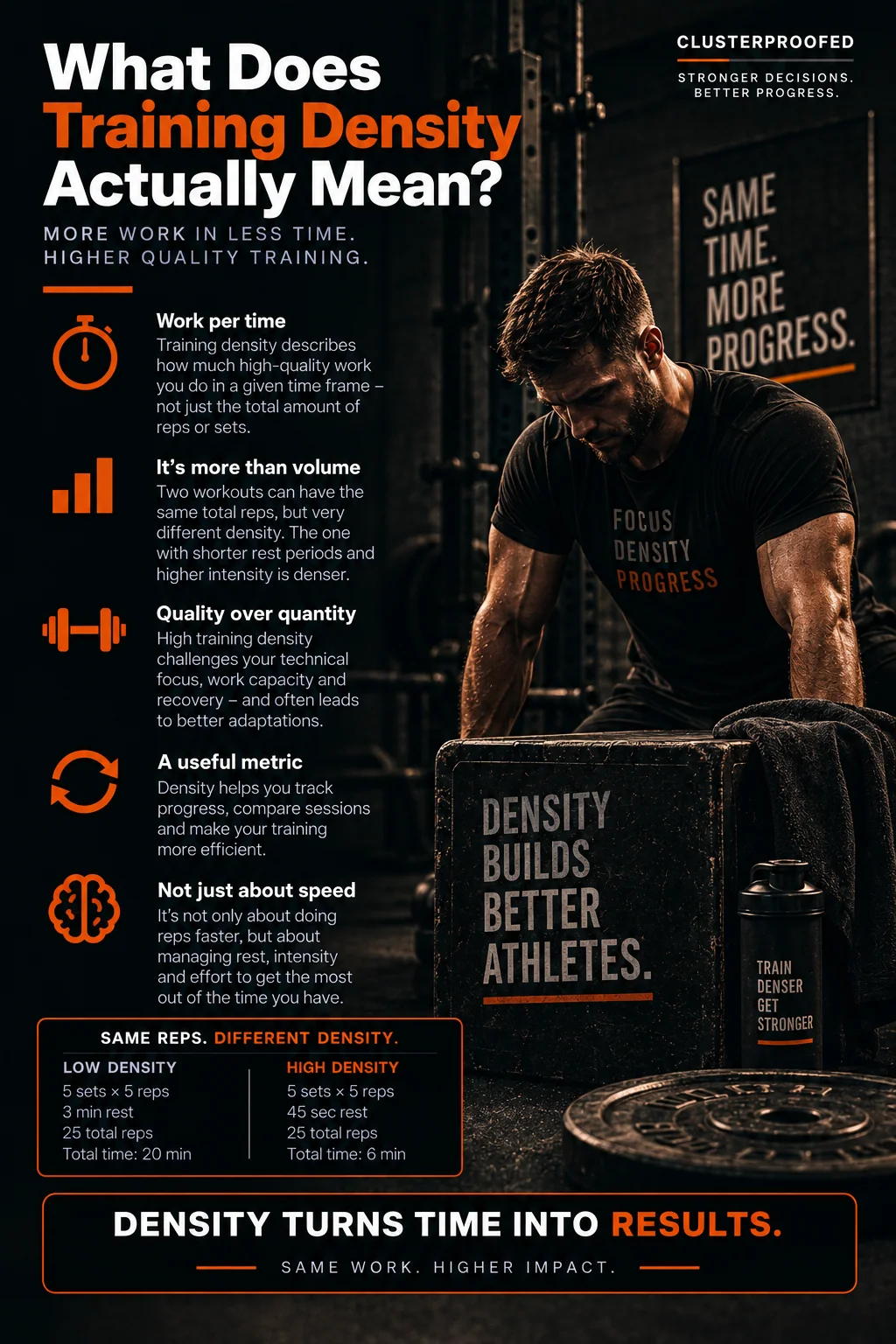
And this is exactly where training density shows why it can be an interesting performance parameter.
Because the body can not only get stronger.
It can also learn to produce more high-quality work within the same amount of time.
More Volume Is Not Automatically Progression
This is where things get a bit more complicated.
In training science, progressive overload is often described through an increase in training volume – for example, more sets, reps, or load moved.
However, recent scientific work points out that the development of training volume can't simply be equated with muscle growth. More total volume isn't automatically the cause of more muscle growth, and larger increases in training volume don't necessarily lead to proportionally larger adaptations.
That's an important distinction.
Because:
More training
is not automatically the same as:
a better training stimulus.
If you keep increasing training volume indefinitely, you can eventually produce more fatigue without the additional benefit rising accordingly.
That's exactly why progression should always be considered in relation to training quality.
The Simple Variant: Double Progression
A very practical method is so-called double progression.
You define, for example:
3 × 8–12
and stay at that weight until you can complete all three sets in the upper range.
Example:
Week 1:
8 / 8 / 8
Week 2:
9 / 8 / 8
Week 3:
10 / 9 / 9
Week 4:
12 / 11 / 10
Week 5:
12 / 12 / 12
Now the weight goes up.
Then the cycle starts again.
This is a simple but very effective form of progression.
And it has a decisive advantage:
You don't have to artificially increase the weight every single week.
Technique Is Also a Form of Progress
Picture two reps with the same weight.
Rep A:
The lower back loses position, the movement becomes hectic, and technique deteriorates.
Rep B:
The movement is stable, controlled, and reproducible.
If, after a few weeks, you move the same load with noticeably better technique, you've improved.
Even if the plates on the bar stayed exactly the same.
This is frequently underestimated.
Because a stronger athlete isn't just someone who can move more weight.
They can move a given load better.
Velocity Can Also Tell Us Something About Progress
At submaximal loads, movement velocity can be interesting too.
If you're moving 100 kg, for example, and you can accelerate the bar noticeably faster than before, that can indicate an improvement in neuromuscular performance capacity.
Of course, velocity alone isn't a complete measure of progress.
But it shows:
Performance isn't only made of weight.
Weight and velocity belong together.
And that's exactly why a load that's moved faster today than a few weeks ago can carry a different meaning – even if the exact same number sits on the bar.
What About More Sets?
Additional sets can be a form of progression too.
If you've trained:
3 × 8
so far, and later do:
4 × 8
you've increased your volume.
That can make sense.
But more sets aren't automatically better.
The additional set has to be considered in context:
- How high is the intensity?
- How good is the technique?
- How high is the fatigue?
- How often is the exercise trained?
- How well can you recover from it?
- How does your performance change in subsequent sessions?
That's the point at which a training plan grows up.
Not every plus is automatically a good plus.
Progression Doesn't Mean Being Stronger Every Single Week
This is probably one of the most important ideas.
Performance fluctuates.
Sleep varies.
Stress varies.
Recovery varies.
Training age also changes how quickly progress tends to show up.
A beginner can often get stronger very quickly.
An advanced athlete sometimes works for weeks or months on small changes.
That's why the expectation:
"I have to do more next week than this week"
is unrealistic in the long run.
Progression has to be viewed over a sufficiently long period.
Not over individual training days.
And This Is Exactly Where Autoregulation Comes In
If daily readiness fluctuates, a rigid progression logic can become problematic.
Say your plan prescribes 100 kg × 5 today.
You slept badly, you're stressed, and you don't feel particularly capable.
That 100 kg might be considerably heavier today than usual.
An intelligent system, therefore, has to be able to distinguish between the planned stimulus and the actually available performance.
That doesn't mean spontaneously making every session lighter.
It means taking actual performance capacity into account.
Progression and autoregulation, then, aren't opposites.
They complement each other.
What Does This Mean for Density8?
Here the concept of progression becomes especially interesting.
Because in a time-based system, development can't be measured through weight alone.
For example:
Same load + same time window + more clean reps
is progression.
Likewise:
More load + same time window + same number of clean reps
is progression.
Or:
Same performance + higher intensity
can represent progression.
The decisive thing is:
The training frame stays defined.
Within that frame, performance capacity changes.
That makes progress more measurable than it might seem at first glance.
The Biggest Mistake with Progression
Many training plans treat progression like a mandatory checklist item:
Today, 100 kg. Next week, 102.5 kg. After that, 105 kg.
That looks nice.
But the body doesn't care about our spreadsheet.
If 102.5 kg produces a poor movement today, the number alone isn't progress.
If 100 kg, on the other hand, is moved more cleanly, faster, and with less fatigue, that can be a real performance increase.
Progression, then, should always be tied to performance.
Not just to weight.
A Better Definition
Maybe we can therefore phrase progressive overload a bit differently:
Progression means that the ability to handle a defined training task improves.
That can happen through more weight.
Through more reps.
Through more high-quality work.
Through higher density.
Through better technique.
Or through a combination of several factors.
And that's exactly why progression isn't a single dial you keep turning further to the right.
It's a process of adaptation.
The Next Step Isn't Always Heavier
Sometimes the next step really is heavier.
Sometimes it's lighter, but technically better.
Sometimes it's two additional reps.
Sometimes an additional set.
Sometimes the same performance with less fatigue.
And sometimes progress simply consists of the fact that the training that felt very demanding three months ago can now be completed under control.
The weight on the bar is only part of the story.
Progression doesn't mean always doing more.
It means being able to perform more.
Sources & Further Reading
The sources were chosen to match the article's central claims. They are meant to make the factual statements traceable; the strength of the evidence varies by topic.
- Hammert, W. B. et al. (2024), Physiological Measurement 45(8), "Progression of total training volume in resistance training studies and its application to skeletal muscle growth." DOI: 10.1088/1361-6579/ad7348
- Schoenfeld, B. J., Ogborn, D. & Krieger, J. W. (2017), Journal of Sports Sciences 35(11), 1073–1082, "Dose-response relationship between weekly resistance training volume and increases in muscle mass: A systematic review and meta-analysis." DOI: 10.1080/02640414.2016.1210197
Important: The sources do not automatically support every specific program prescription in Clusterproofed. Time windows, cluster sizes, and percentage-based loads are training-design decisions of the system and should be understood as such.