If there's one number in strength training that has achieved something close to cult status, it's probably:
8–12 reps.
The classic muscle-building range.
Three sets. Eight to twelve reps. Heavy weight. Muscle burns.
Done.
The problem?
Muscle building isn't that simple.
Because research from recent years shows fairly clearly that muscles can grow across a much wider rep range than that.
The better question, then, isn't:
"Which rep count is optimal?"
But:
"Which rep ranges suit which training goals – and under what conditions?"
Muscle Growth Doesn't Only Happen with 8–12 Reps
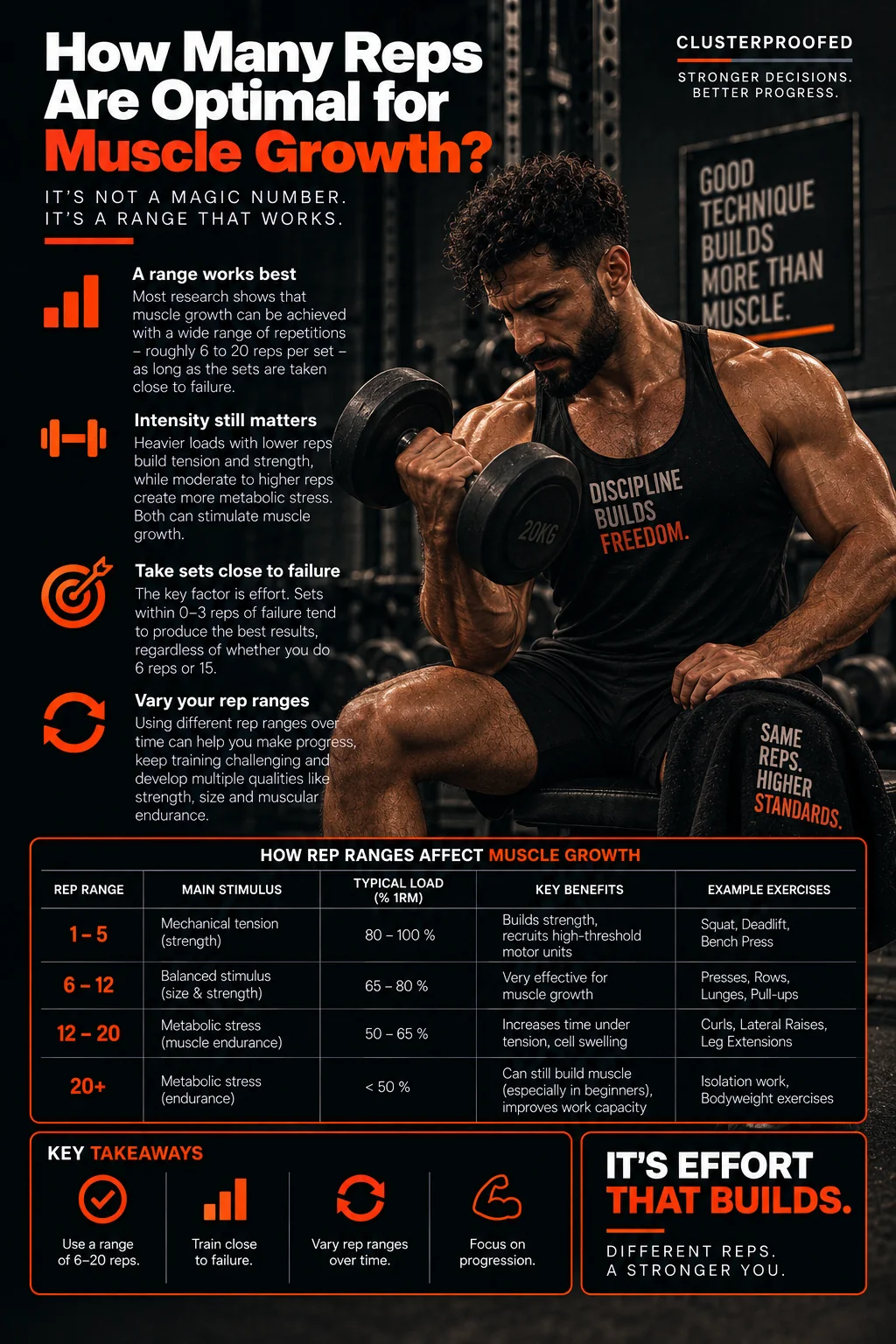
A large meta-analysis compared different training loads and found no meaningful differences in muscle hypertrophy between higher and lower loads, while heavier loads showed a greater advantage for developing maximal strength.
That means:
A muscle can grow with heavy weights and few reps.
But it can also grow with lighter weights and considerably more reps.
The famous 8–12 rep zone, then, isn't a biological window that suddenly opens and then closes again at rep 13.
It's more of a very practical middle ground.
Why Do Different Rep Ranges Work?
An important factor is effort.
If a set with a relatively light load is ended far from the individual's performance limit, the stimulus may be smaller than in a set that comes noticeably closer to maximal possible output.
At heavier loads, on the other hand, just a few reps are enough to create a high mechanical demand.
Put simply:
Heavy load → fewer reps needed
Light load → more reps needed
The two approaches aren't automatically equally pleasant, though.
And that's where practical differences come into play.
5 Reps Are Something Different from 20
Even though both variants can enable muscle growth.
Five heavy reps mean:
- high absolute load
- high demands on technique and stability
- relatively high force requirement
- low rep count
20 reps mean:
- lower absolute load
- considerably longer set duration
- stronger local fatigue
- considerably more reps
The muscle can respond to both forms of training.
But the training doesn't feel the same.
And it doesn't stress all systems the same way either.
That's why the question of the optimal rep range isn't purely a matter of muscle physiology.
It's also a matter of training economy.
The Practical Sweet Spot Is Often in the Middle
For many exercises, moderate rep ranges are remarkably practical.
For example:
5–8 reps
or
8–12 reps
or
10–15 reps
Why?
Because they let you create relatively high mechanical tension without sets becoming extremely short or extremely long.
They also make performance relatively easy to document.
If you lift 80 kg for 10 clean reps today and 80 kg for 13 a few weeks later, the change is clearly visible.
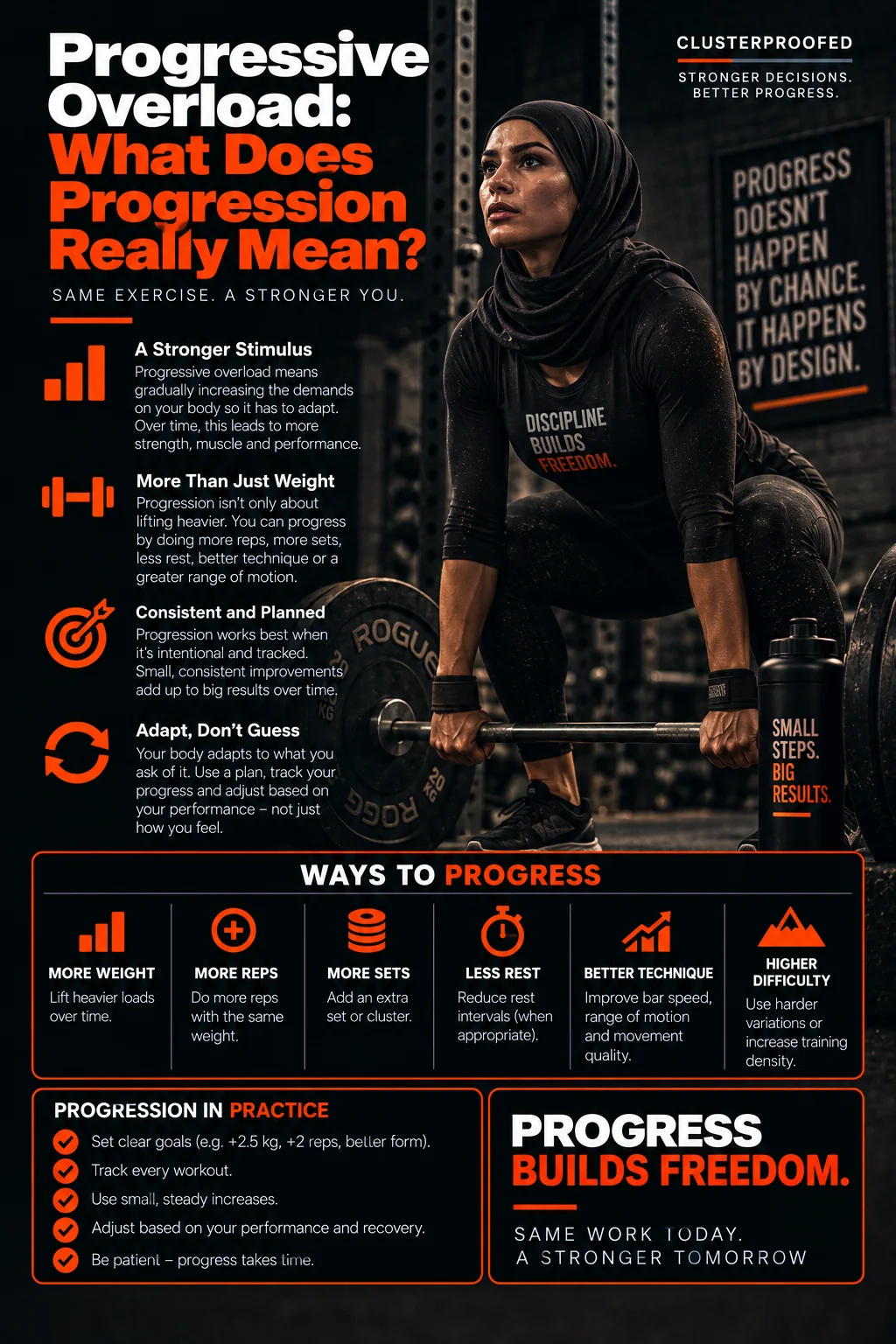
That's what makes moderate rep ranges interesting for progression, too.
What About Very Heavy Weights?
1–5 reps can build muscle too.
They're particularly interesting for strength development, however.
That shows up in the current evidence as well: heavier loads tend to be superior for developing maximal strength, while hypertrophy across different load ranges depends far less on load.
If your primary goal is:
"I want to get stronger."
low rep counts make a lot of sense.
If your goal is:
"I want to build muscle as efficiently as possible."
a broader rep range can make sense.
What About 20, 30, or Even 40 Reps?
Very high rep counts can support muscle growth too.
But this is where the practical side comes in.
The lighter the weight gets, the longer a set often has to last to produce a sufficiently high training stimulus.
That can work.
But it can also become unpleasant.
A set of 30 squats is a completely different task from a set of eight.
Local and systemic fatigue can climb high before a comparable mechanical stimulus is even reached.
That's why:
"Can build muscle"
doesn't automatically mean:
"Is the best choice for every training session."
The Rep Maximum Is Not a Magic Line
A common misconception is the idea that, say, 10 reps are optimal for muscle building and 15 are already noticeably worse.
That's not how physiology works.
There's no switch that flips at rep number twelve.
It's far more useful to view rep ranges as tools.
Heavy ranges are excellent for strength.
Moderate ranges are versatile and practical.
Higher rep ranges can be effective too, and are, for example, very comfortably applicable to certain isolation exercises.
The choice depends on the goal and the exercise.
And Then There's Another Important Factor: Proximity to Failure
Two sets of 15 reps can be completely different.
15 reps with six more still possible
is something different from:
15 reps with only one more possible.
The rep count alone, then, says surprisingly little about the actual load.
That's one reason modern training planning increasingly uses concepts like RIR – Reps in Reserve or RPE – Rate of Perceived Exertion.
A rep count describes how many reps were done.
RIR describes how close you were to your individual performance limit.
The two together are far more informative.
Does Every Set Have to Go to Muscular Failure?
No.
That's an important point.
Meta-analyses conclude that different load ranges can enable muscle hypertrophy without requiring every set to be taken to absolute failure.
That doesn't mean failure training is useless.
It means:
It's a tool – not an obligation.
The Optimal Rep Count Depends on the Exercise
This is often forgotten.
A heavy set of 20 deadlifts is a completely different task from 20 bicep curls.
For complex compound lifts, moderate to low rep counts can have advantages:
- technique remains easier to control
- fatigue stays more manageable
- heavy loads are possible
- individual reps can be very high quality
For smaller exercises, higher rep ranges can work excellently, on the other hand.
A training plan that prescribes the same rep count for every exercise would therefore be simple – but not necessarily particularly intelligent.
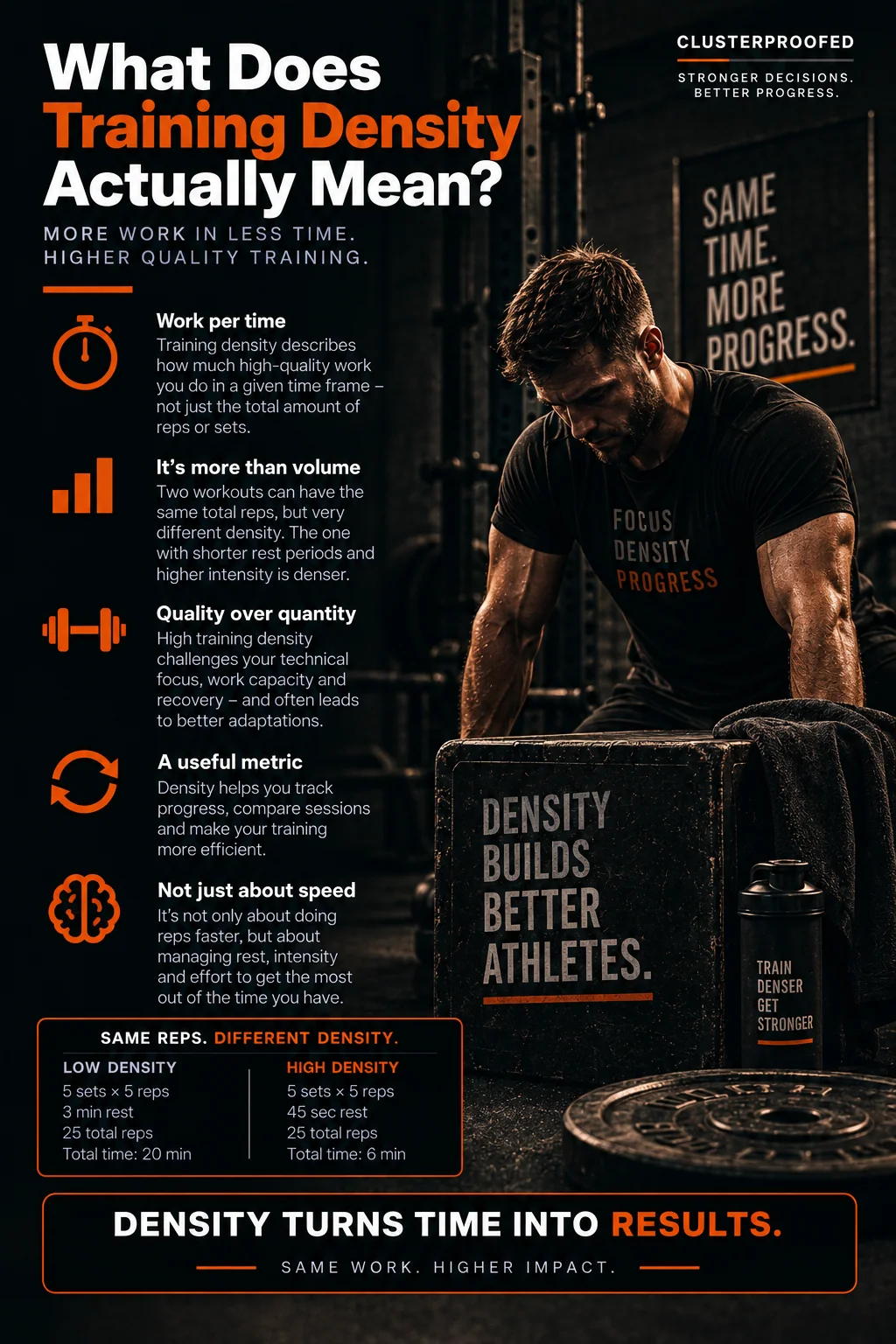
What Does This Mean for Density8?
Here it gets interesting.
If time and density are also training variables, rep count can't be considered in isolation.
A triple cluster at 80% 1RM is a different task from a set of 10 at 70%.
And a double cluster at 85% is different again.
Rep count, in this context, doesn't only determine volume.
It also influences:
- cluster size
- the necessary rest
- how fatigue develops
- rep velocity
- the number of high-quality reps possible within a time window
That turns the seemingly simple question "How many reps?" into a much more interesting one:
How many reps can I sensibly organize with the desired load, quality, and fatigue structure?
That's a different way of looking at reps.
So: How Many Reps Are Optimal?
If you want a short answer:
There's no single optimal rep count for muscle building.
A broad range can work.
For many trainees, roughly 5–15 reps is a remarkably practical range. Higher or lower rep counts can be sensible too – depending on exercise, training goal, load, and proximity to failure.
For maximal strength, the emphasis shifts more toward heavier loads and lower rep counts.
For hypertrophy, the selection is considerably broader.
And that's exactly why you shouldn't make yourself dependent on a single number.
8–12 is not a law.
It's a tool.
Just like 5, 6, 10, 15, or 20 reps are.
The decisive question isn't:
"Which number is magic?"
But:
"Which rep count lets me produce high-quality training work and generate progress with this load over weeks?"
That's the far more interesting question.
Sources & Further Reading
The sources were chosen to match the article's central claims. They are meant to make the factual statements traceable; the strength of the evidence varies by topic.
- Schoenfeld, B. J. et al. (2017), Journal of Strength and Conditioning Research 31(12), 3508–3523, "Strength and Hypertrophy Adaptations Between Low- vs. High-Load Resistance Training: A Systematic Review and Meta-analysis."
- Schoenfeld, B. J. et al. (2016), European Journal of Sport Science 16(1), 1–10, "Muscular adaptations in low- versus high-load resistance training: A meta-analysis." DOI: 10.1080/17461391.2014.989922
- Grgic, J. et al. (2022), Journal of Sport and Health Science, "Effects of resistance training performed to repetition failure or non-failure on muscular strength and hypertrophy: A systematic review and meta-analysis." DOI: 10.1016/j.jshs.2021.01.007
Important: The sources do not automatically support every specific program prescription in Clusterproofed. Time windows, cluster sizes, and percentage-based loads are training-design decisions of the system and should be understood as such.