A training plan can specify fairly precisely what's on the schedule for today.
For example:
Squat – 3 × 5 at 100 kg.
Clear. Simple. Measurable.
The problem is:
The training plan doesn't know how you slept last night.
It doesn't know what your stress level looks like. Whether you worked twelve hours yesterday. Whether your last session is still sitting in your bones. And it certainly doesn't know how 100 kg will feel today.
The load on the bar is objective.
Your capacity to handle that load is not.
This is exactly where autoregulation begins.
What Does Autoregulation Mean?
In simple terms, autoregulation means:
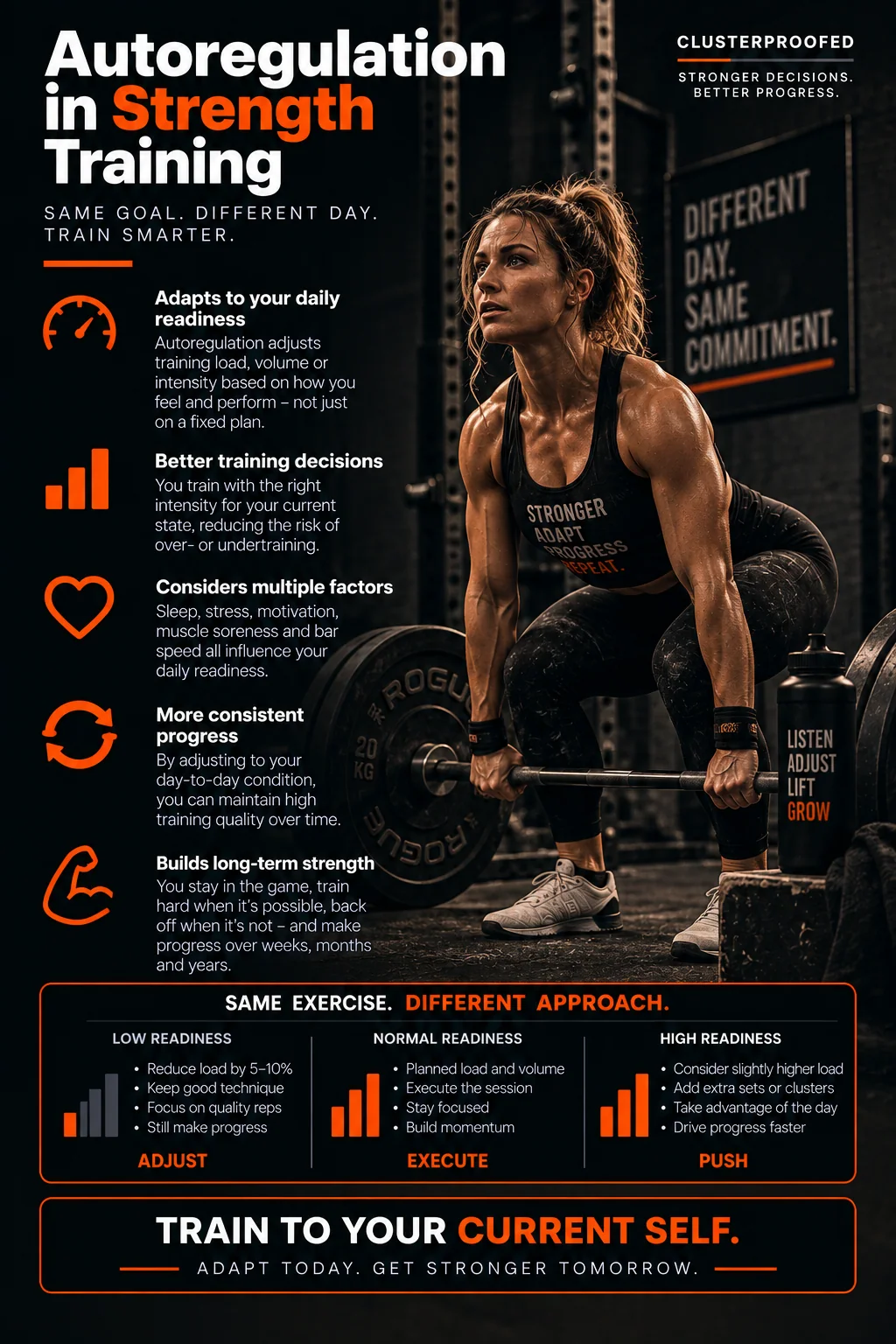
The training load is adjusted to match current performance capacity.
That doesn't mean training without a plan.
And it doesn't mean:
"I don't feel like it today, so I'll do less."
Autoregulation is not a free pass.
It's a method for matching a planned training stimulus with the athlete's actual daily readiness.
The plan defines the frame.
Current performance capacity determines how that frame gets filled today.
This can mean, for example:
- adjusting the weight,
- adjusting the reps,
- changing the number of sets,
- managing proximity to failure,
- or gathering as many high-quality reps as possible within a defined time window.
The decisive point:
The training goal stays in place. The specific load is allowed to vary.
Why Daily Readiness Matters at All
Strength is not a constant quantity.
Even if your body weight doesn't change and you theoretically have the same amount of muscle mass, your performance capacity can fluctuate from day to day.
Sleep.
Stress.
Nutrition.
Previous training sessions.
General fatigue.
Motivation.
Many other factors can influence how capable you feel on a given day.
That doesn't mean every small fluctuation is dramatic.
But at high training intensities, even relatively small differences can become relevant.
100 kg can feel light today.
And suddenly heavy on the next training day.
The bar is the same.
You are not.
A 1RM Is Not an Eternal Value
This can be explained particularly well through the 1RM.
If you have, say, a theoretical 1RM of 120 kg, that doesn't mean you can move exactly 120 kg on any given day.
The 1RM is a performance figure under specific conditions.
It describes a maximal output – not an unchanging physical property.
That's why a training weight set as a percentage of the 1RM can feel differently heavy on different days.
90% of 120 kg is always 108 kg.
But:
108 kg is not the same training task every day.
This is exactly where purely percentage-based planning hits its limits.
Autoregulation Is Not the Same as "Training by Feel"
This distinction is crucial.
"I'll do whatever I feel like today" is not autoregulation.
Autoregulation needs rules.
A simple example is RPE.
RPE stands for Rate of Perceived Exertion and describes how strenuous a performance feels subjectively.
In strength training, RPE is often linked to remaining rep reserve.
An RPE of 10 means roughly:
No further clean rep would be possible.
RPE 9:
About one more rep would be possible.
RPE 8:
About two more reps would be possible.
The same concept is often described using RIR – Reps in Reserve.
RIR 2 means:
I probably had about two more clean reps in me.
This turns a subjective feeling into a concrete steering variable.
RIR Is Not a Weakness
There's an interesting psychological trap in strength training here.
Many trainees think:
The harder the set, the better the training.
That sounds logical.
But it isn't necessarily true.
A set taken to absolute failure produces a high training stimulus – but also considerable acute fatigue.
For strength, meta-analyses find no clear advantage; for hypertrophy, the evidence is less clear, and proximity to failure may play a role.
This is what makes RIR interesting.
Because sometimes the better decision isn't:
"How much can I possibly do today?"
But:
"How much do I need to do today to set the desired training stimulus?"
That's a fundamental difference.
Autoregulation and Progression Are Not Opposites
At first glance, you might think autoregulation makes progressive training planning harder.
If the weight keeps being adjusted, how are you supposed to measure progress at all?
The answer:
Progression isn't abolished. It's interpreted more intelligently.
Say you're training squats with a goal of 3 × 5.
A classic plan might say:
Week 1: 100 kg
Week 2: 102.5 kg
Week 3: 105 kg
Autoregulation might instead say:
Work within the prescribed load range today and maintain technical quality along with the desired level of effort.
On a very good day, that might turn into 105 kg.
On a bad day, maybe 97.5 kg.
That doesn't automatically mean you're getting worse.
It may simply mean your current performance capacity is lower today.
Over several weeks, the trend can still clearly point upward.
The Training Plan Defines the Task
This is probably the most important idea behind autoregulation.
A good training plan doesn't necessarily have to prescribe every single variable down to the last kilogram.
It can instead define a training task.
For example:
High intensity.
2-rep clusters.
15 minutes.
Technically clean reps.
That specifies fairly precisely what's supposed to be trained.
But it leaves room for reality.
Maybe the planned load feels heavier today.
Then an adjustment can make sense.
Maybe it feels unusually light.
Then performance can turn out correspondingly higher.
The frame stays in place.
The execution adapts.
This Is Exactly Where Clusters Become Interesting
Cluster training and autoregulation fit together particularly well.
In a classic set of, say, ten reps, fatigue within the set can rise sharply.
The last reps get slower.
Technique can change.
Velocity drops.
With clusters, fatigue within the series is controlled more tightly.
This creates a further advantage:
The individual rep becomes a more observable unit of performance.
That's particularly interesting at high intensities.
If you're working at 85% of your 1RM using double clusters, you can ask not only:
Did I complete my two reps?
But also:
Were both reps technically clean?
How did velocity change?
How much output could I sustain within the time window?
This makes autoregulation more concrete.
Autoregulation Needs Boundaries
Here lies an important distinction between an intelligent system and arbitrary "training by feel."
Autoregulation works best when there are guardrails.
For example:
- defined intensity ranges,
- defined rep ranges,
- RIR or RPE targets,
- fixed time windows,
- technical criteria,
- minimum and maximum limits.
This doesn't create arbitrary training.
It creates a controlled range of movement.
You could put it this way:
The plan determines the road. Autoregulation determines the speed.
Time Can Become a Guardrail
This is exactly where the connection to Time-Based Density Training gets interesting.
A classic training plan might prescribe, for example:
4 × 5 reps.
A time-based system can instead say:
15 minutes.
That's a different kind of prescription.
The time is fixed.
Within that time window, performance is allowed to vary.
On a good day, maybe more high-quality clusters can be completed.
On a worse day, fewer.
The training task stays the same regardless.
And that's exactly a form of autoregulation.
Not the time being adjusted.
Not the task being abandoned.
The performance actually delivered is adjusted to current capacity.
Autoregulation Makes Performance Measurable
That sounds paradoxical at first.
If the same rep count isn't always prescribed, training should presumably become less measurable.
In a well-structured system, the opposite can happen.
Take a constant 15-minute time window.
Today:
10 clean clusters
Four weeks later:
12 clean clusters
The weight is the same.
The time is the same.
The exercise is the same.
But performance within this frame has increased.
That's a fairly clear form of progress.
Performance, then, isn't measured exclusively through the weight on the bar.
It can also be measured through the work delivered within a defined frame.
Autoregulation Doesn't Mean Training Less
This is another important point.
Autoregulation is sometimes misunderstood as:
If it's hard, do less.
That can be a sensible decision.
But autoregulation can just as well mean:
Today, performance capacity is higher than expected – use it.
If a planned load turns out noticeably lighter than expected, performance can turn out correspondingly higher.
Autoregulation, then, works in both directions.
It doesn't just protect against overload. It also prevents good training days from being artificially held back.
The Real Goal Isn't Maximal Daily Performance
And here, perhaps, lies the most important idea of all.
A training system shouldn't try to turn every single training day into the best training day of your life.
That wouldn't be a particularly good strategy in the long run.
The goal, rather, is:
to deliver as much high-quality performance as possible across many training sessions.
A single maximal session can be impressive.
But twelve solid sessions in a row are probably far more interesting for long-term development.
Autoregulation helps manage the load so that training quality is maintained over a longer period of time.
Autoregulation and TRIAD
Here too, the connection to TRIAD can be drawn quite directly.
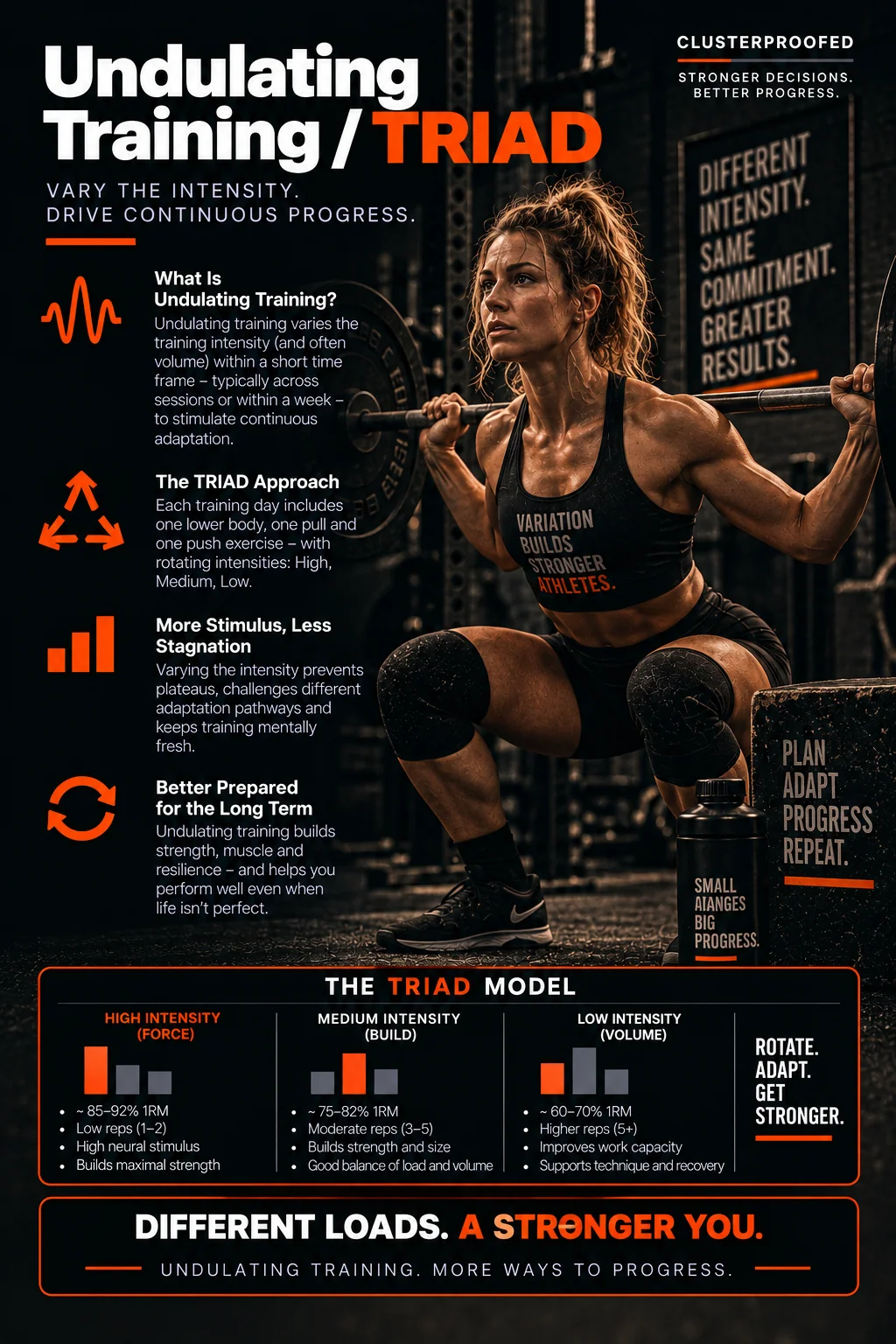
TRIAD defines three different training regimes:
Volume – 70% 1RM, 5-rep clusters, 15 minutes
Build – 80% 1RM, 3-rep clusters, 15 minutes
Force – 85% 1RM, 2-rep clusters, 15 minutes
This gives the training task a clear definition.
But actual performance within the respective time window can vary from session to session.
And that's not a flaw in the system.
It's part of the system.
If, say, fewer high-quality double clusters are possible in the Force regime today than last time, that doesn't automatically mean the training was worse.
Maybe daily readiness was lower.
Maybe the previous load was higher.
Maybe recovery wasn't optimal.
What matters is that the defined task was fulfilled.
And if, over several weeks at the same load, more and more high-quality work can be gathered within the time window, that's a clear form of performance improvement.
Autoregulation Is Controlled Flexibility
Perhaps the whole concept can best be described in three words:
Structured flexibility.
Too little structure leads to arbitrary training.
Too little flexibility leads to a training plan that ignores reality.
Autoregulation tries to bring the two together.
The plan says:
This is the task.
Daily readiness says:
This is what's possible within this task today.
And performance over weeks and months shows:
This is your development.
That's a considerably more realistic model of human performance capacity than assuming a given training weight has to feel exactly as heavy every single day.
A Good Training Plan Knows Its Limits
A training plan can't know how you'll feel tomorrow.
That's not a weakness of the training plan.
It's a fact of the human body.
That's why a good training plan doesn't need to try to predict the future down to the last kilogram.
It needs to create a sensible frame within which adaptation is possible.
Autoregulation expands this frame.
It doesn't make training more arbitrary.
At its best, it makes it more realistic.
Because in the end, it's not about doing exactly what was written on a piece of paper weeks ago, every single day.
It's about repeatedly setting the right training stimulus over a long period of time.
And sometimes that means delivering a bit more.
Sometimes a bit less.
Both can be right.
The plan sets the direction.
Daily readiness determines the specific performance.
Long-term development shows whether the system is working.
Sources & Further Reading
The sources were chosen to match the article's central claims. They are meant to make the factual statements traceable; the strength of the evidence varies by topic.
- Greig, L. et al. (2020), Sports Medicine, "Autoregulation in Resistance Training: Addressing the Inconsistencies." PubMed 32813181
- Huang, Z. et al. (2025), Journal of Exercise Science & Fitness 23, 360–369, "Autoregulated resistance training for maximal strength enhancement: A systematic review and network meta-analysis." DOI: 10.1016/j.jesf.2025.07.006
- Grgic, J. et al. (2022), Journal of Sport and Health Science, "Effects of resistance training performed to repetition failure or non-failure on muscular strength and hypertrophy: A systematic review and meta-analysis." DOI: 10.1016/j.jshs.2021.01.007
- Robinson, Z. P. et al. (2024), Sports Medicine, "Exploring the Dose-Response Relationship Between Estimated Resistance Training Proximity to Failure, Strength Gain, and Muscle Hypertrophy: A Series of Meta-Regressions." DOI: 10.1007/s40279-024-02069-2
Important: The sources do not automatically support every specific program prescription in Clusterproofed. Time windows, cluster sizes, and percentage-based loads are training-design decisions of the system and should be understood as such.