There's hardly a term in strength training used as casually as compound exercises.
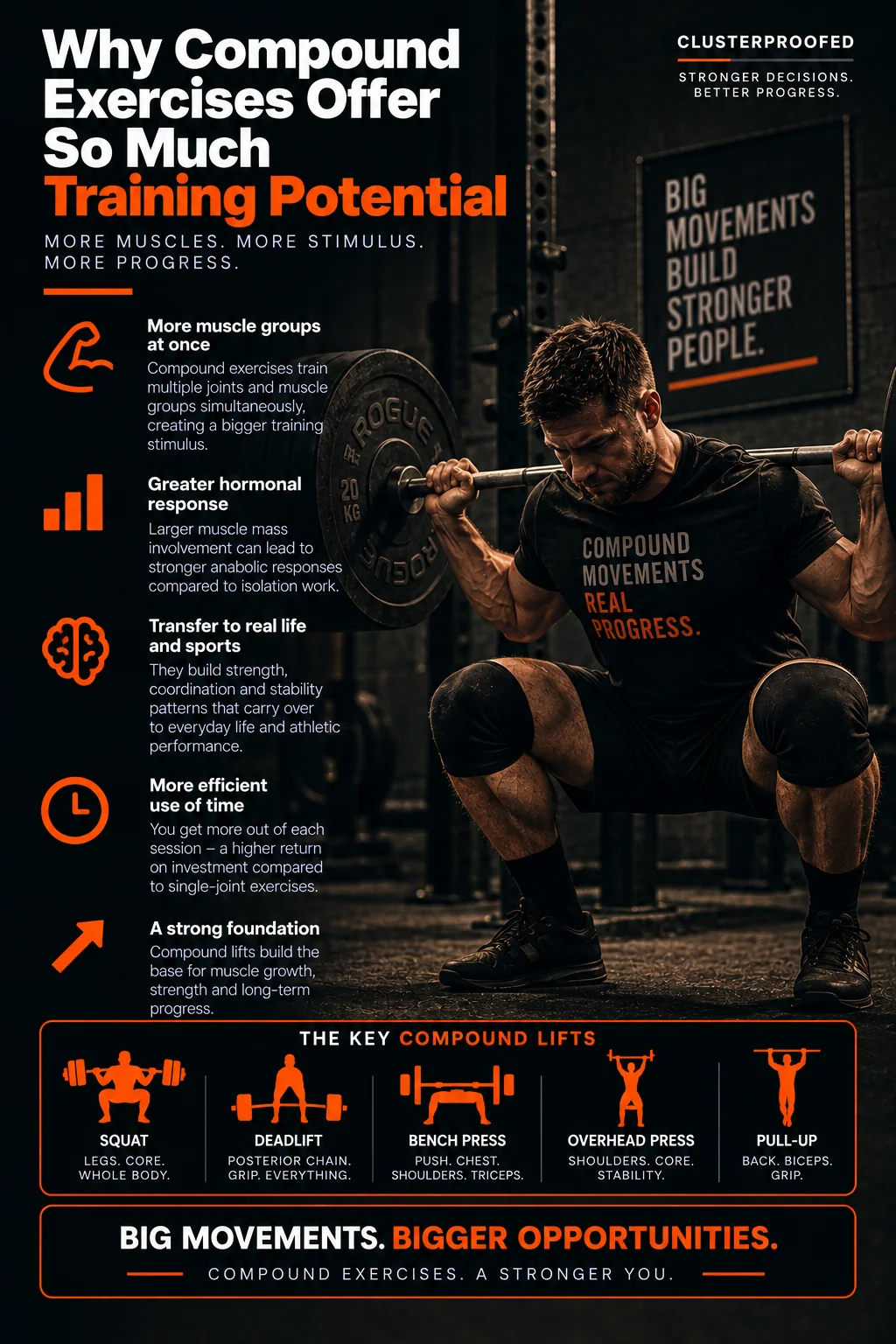
Squat. Deadlift. Bench press. Pull-ups. Rows. Dips. Overhead press.
The big movements.
It's often said you simply have to do them. That they're "better," more effective, or more important than isolation exercises.
It's not quite that simple, though.
A compound exercise isn't automatically the best exercise for every training goal. A bicep curl doesn't become pointless just because you do pull-ups. And a machine doesn't suddenly become a bad training method just because it involves fewer muscles at once.
The real advantage of compound exercises lies elsewhere:
A single exercise can organize a huge amount of training work at once.
And that's exactly what makes them particularly interesting for strength training.
What Is a Compound Exercise, Anyway?
In simple terms, a compound exercise is a multi-joint movement in which several muscles and joints are involved in force production at the same time.
In a squat, for example, it's not just the thighs working.
The hips and torso have to contribute to the movement and stabilization as well.
In a pull-up, the shoulder and elbow move together, while numerous muscles of the upper body and torso contribute to movement and stabilization.
In a deadlift, the legs, hips, and torso have to jointly produce a high force output.
That's the essential difference from a classic isolation exercise.
In a bicep curl, the movement is deliberately concentrated on one muscle and one joint.
In a pull-up, on the other hand, the body has to coordinate a complex force task.
And that's where some interesting advantages come from.
1. Compound Exercises Offer High Training Economy
Perhaps the biggest advantage is remarkably simple:
You get a lot of training for one exercise.
When you do a pull-up, you're not just training your lats.
Among other things, you have to move and stabilize your shoulder, bend your elbow, and control your entire body.
When you do a squat, several muscle groups have to contribute to the movement at once and stabilize the body under load.
That doesn't mean every one of these muscles is trained maximally as a result.
But many structures contribute at the same time.
That makes compound exercises particularly efficient.
Instead of using five different exercises to cover different parts of a movement, a complex exercise can already take care of a large part of the work.
That's especially interesting when available training time is limited.
2. They Train Movements, Not Just Muscles
That's an important distinction.
Strength doesn't arise exclusively within a single muscle.
The body has to coordinate muscles, transfer forces, and stabilize joints.
A compound exercise, therefore, poses a task to a system.
In the deadlift, for example, forces have to be transferred from the feet through the legs and hips into the torso and finally into the bar.
In the pull-up, the body has to coordinate the pulling movement while simultaneously controlling the position of the shoulder blade, shoulder, and torso.
This means:
Compound exercises train strength within the context of a movement.
That's especially relevant when strength isn't understood merely as muscle size, but as the ability to actually produce high forces within a movement.
3. Big Movements Allow Big Loads
Multi-joint exercises often allow considerably higher absolute training loads than isolation exercises.
No one would think of training a single muscle in isolation with a heavy squat or deadlift load.
The load is distributed across multiple structures.
That allows for high external resistance.
And high resistance creates a very clear way to track strength development.
100 kg deadlift.
110 kg.
120 kg.
130 kg.
The numbers are immediately comprehensible.
Of course, weight alone isn't a complete measure of training progress. Technique, range of motion, rep count, and fatigue play a role too.
But with complex compound exercises, performance is often quite easy to observe.
4. Compound Exercises Make Progression Visible
That leads directly to the next advantage.
Compound exercises are excellent for observing progression.
Not just through weight.
Also through:
- more reps at the same weight,
- the same weight with better technique,
- more performance within a time window,
- higher movement velocity at the same load,
- lower perceived effort at the same performance.
That turns an exercise into a relatively well-observable performance model.
Take a pull-up.
If you do five clean reps with your body weight today and eight a few weeks later, your performance capacity has changed.
If you can later add 10 kg, your performance capacity has changed as well.
And if you later produce the same performance in less time, that's also a form of progression.
The exercise thus becomes a measuring instrument for physical performance capacity.
5. They Create a High Mechanical Demand
Compound exercises make it possible to load large muscle groups with relatively high resistance.
That's particularly relevant for strength training.
Because mechanical tension is one of the central factors in adapting to resistance training.
That doesn't mean, however:
The bigger the barbell, the better the muscle growth.
That would be too simple.
For hypertrophy, lighter loads can be effective too, provided enough hard sets are performed.
And an isolation exercise can even be very sensible for a particular muscle.
The point is a different one:
Compound exercises offer an efficient way to distribute high mechanical demands across several involved muscles and structures.
6. They Demand Coordination
A compound exercise isn't simply the sum of its involved muscles.
The muscles have to work together.
That sounds obvious, but it's decisive for strength development.
When several joints are involved in a movement at once, the nervous system has to coordinate the involved muscles in both time and space.
That's why someone can have a relatively large amount of muscle mass and still struggle to perform a complex movement efficiently under a heavy load.
Strength isn't only a question of muscle size.
It's also a question of how well existing physical resources can be deployed.
That's one reason why the execution of a compound exercise can itself become a training goal.
7. Technique Becomes Part of the Performance
With a complex movement, you can't simply "add more weight" and assume the task stays the same.
Technique changes.
And that's exactly why technical quality matters so much.
A clean squat at 100 kg isn't necessarily the same performance as a noticeably shortened movement at 110 kg.
A pull-up with a full range of motion isn't the same as a half pull-up with momentum.
This means:
In compound exercises, technical quality is itself a training variable.
That's remarkably interesting from a progression standpoint.
Because progress can mean you're moving more weight.
But it can just as well mean you're moving the same weight better.
8. Compound Exercises Are Especially Interesting with Limited Training Time
And this is where things become particularly relevant for Time-Based Density Training.
If you only have a limited amount of time available, you don't necessarily want to perform as many exercises as possible.
You want to produce as much high-quality work as possible within that time window.
Complex movements are very well suited for exactly this.
A 15-minute session of squats can generate a substantial amount of training work for the lower body and torso.
15 minutes of pull-ups or rows can engage a large portion of the pulling musculature.
15 minutes of a pressing movement can challenge the chest, shoulders, and triceps at the same time.
That doesn't mean isolation training has no place.
It means:
When time is a limited resource, exercises with high training economy become more valuable.
And time is, indeed, a limited resource.
Compound Exercises Are Still Not Automatically Better
Here, a clear distinction is worth making.
The statement
"Compound exercises are better than isolation exercises"
is scientifically too sweeping.
An isolation exercise can be exactly what a training plan needs.
If, for example, the triceps needs targeted additional load, a triceps exercise is a very direct way to get it.
If a muscle needs additional work after a compound exercise, isolation training can make sense.
And machines can load certain muscles with high stability and low coordinative demand.
That's not a contradiction.
Compound exercises and isolation exercises solve different problems.
The question, then, isn't:
Which type of exercise is better?
But:
Which exercise best fulfills the current training task?
The Difference Between "Heavily Involved" and "Maximally Trained"
There's a common mistake here too.
Just because many muscles are involved in an exercise doesn't automatically mean every one of those muscles is being optimally trained for hypertrophy.
A pull-up, for example, engages several muscles.
But that doesn't mean it replaces every conceivable back or arm exercise.
A compound exercise, then, isn't automatically a complete training program.
It's a powerful tool.
And depending on the goal, additional exercises can make sense.
Compound Exercises and Training Efficiency
This brings us to a term that's becoming increasingly interesting in modern strength training:
Training efficiency.
Efficiency doesn't mean training as little as possible.
It means producing as much sensible training work as possible with a given amount of time and resources.
Compound exercises have a structural advantage here.
A single movement can, at the same time:
- load several muscles,
- move several joints,
- produce high forces,
- train coordination,
- develop technical skills,
- and provide a well-measurable performance metric.
That's a lot of training potential packed into a single exercise.
This Is Exactly Why Compound Exercises Fit Density8
Time-Based Density Training asks a somewhat different question than a classic training plan.
Not just:
How many sets did I do?
But:
What did I achieve within a defined amount of time?
And the more limited that time window is, the more interesting movements with high training economy become.
That's one reason complex compound exercises fit so well into a time-based system.
A single movement can be performed at high quality repeatedly over several minutes.
The load can be structured through clusters.
Intensity can be defined.
And performance within the time window can be observed.
That turns a compound exercise into more than just an exercise.
It becomes a repeatable training task.
Fewer Exercises Can Create More Possibilities
That sounds paradoxical at first.
But a good training system doesn't necessarily need a large number of different exercises.
The more complex an exercise is, the more possibilities it offers on its own.
Squats can be trained heavy, moderate, or light.
Pull-ups can be structured through added weight, reps, clusters, or time.
Bench press can be controlled through intensity, volume, and density.
The exercise stays the same.
The training task changes.
That's particularly interesting for systems that don't primarily operate through a constantly rotating selection of exercises.
Compound Exercises Are Tools – Not a Religion
Maybe this is the most important conclusion.
Compound exercises aren't valuable because they're "more natural" or fundamentally better.
They're valuable because they can combine several training tasks at once.
They allow high loads.
They demand coordination.
They engage several muscle groups.
They provide a good foundation for measurable progression.
And they can generate a great deal of training work within a limited time window.
But they're not the only way to train effectively.
A good isolation exercise can be exactly the right choice.
A machine can be exactly the right choice.
A compound exercise can be exactly the right choice.
The best exercise isn't the one that engages the most muscles at once.
The best exercise is the one that best fulfills the training task at hand.
And when the task is to produce as much high-quality performance as possible in a limited amount of time, compound exercises earn a pretty convincing place in the toolbox.
Not because they're magic.
But because they deliver so much training potential at once.
Sources & Further Reading
The sources were chosen to match the article's central claims. They are meant to make the factual statements traceable; the strength of the evidence varies by topic.
- Gentil, P., Soares, S. & Bottaro, M. (2015), Asian Journal of Sports Medicine 6(2), e24057, "Single vs. Multi-Joint Resistance Exercises: Effects on Muscle Strength and Hypertrophy." PubMed 26446291
- Gentil, P. et al. (2017), Sports Medicine, "A Review of the Acute Effects and Long-Term Adaptations of Single- and Multi-Joint Exercises during Resistance Training."
- Schoenfeld, B. J. et al. (2017), Journal of Strength and Conditioning Research 31(12), 3508–3523, "Strength and Hypertrophy Adaptations Between Low- vs. High-Load Resistance Training: A Systematic Review and Meta-analysis."
Important: The sources do not automatically support every specific program prescription in Clusterproofed. Time windows, cluster sizes, and percentage-based loads are training-design decisions of the system and should be understood as such.