Strength training is often thought of as a straight-line process.
More weight. More reps. More sets. Eventually, more performance.
That works – and works quite well, in fact. But training doesn't always have to be built linearly. Especially once you're training regularly and have already reached a certain level, it can make sense to deliberately vary the load within a single week.
This is exactly where undulating training comes in.
The basic idea is remarkably simple:
The load doesn't stay the same every training day. It waves.
Hard. Medium. Light.
Or, more concretely: Volume. Build. Force.
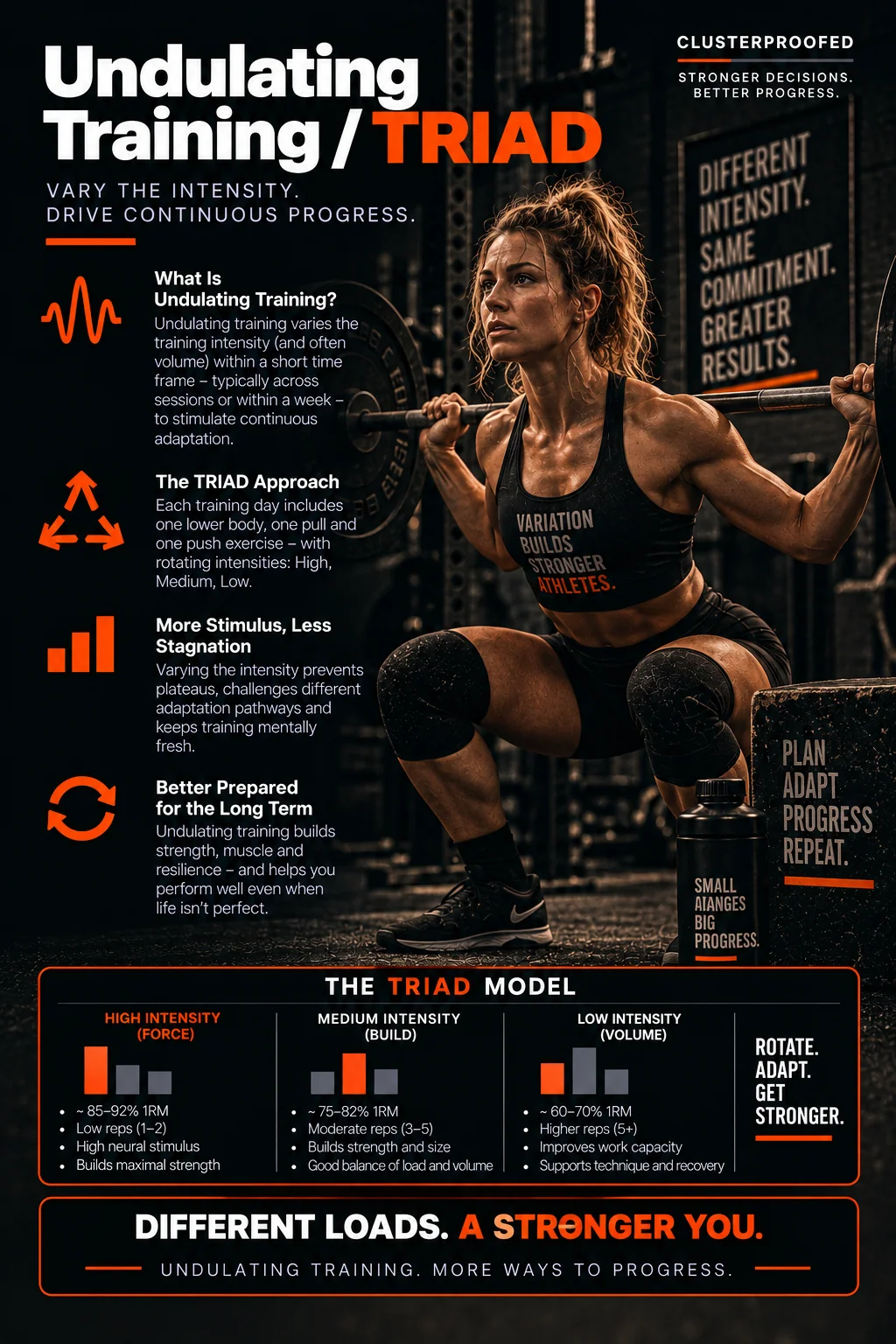
The best-known form of this principle is Daily Undulating Periodization, or DUP for short.
The point isn't to make every training day as different as possible. It's about a planned variation of training load within a relatively short period of time.
And that's exactly where the interesting difference from classic linear periodization lies.
Linear or Undulating?
In linear periodization, load typically changes over longer periods of time.
For example:
Weeks 1–4: 12 reps at a moderate load
Weeks 5–8: 8 reps at a higher load
Weeks 9–12: 5 reps at an even higher load
The load, then, develops in one direction over several weeks.
The undulating model works differently.
Here, load can already change within a single week.
For example:
Monday: hard Wednesday: medium Friday: light
Or, more precisely, the three training days work with different intensities and rep ranges.
A week could look like this:
High: 85–90% 1RM Medium: 75–82% 1RM Low: 65–72% 1RM
The next week, the wave begins again.
The specific percentage split doesn't matter as much.
What matters is the systematic variation of training load.
Daily Undulating Periodization
Daily Undulating Periodization became interesting mainly because it can combine different training demands within a single training week.
Instead of, say, working with high rep counts exclusively for several weeks and then switching to low rep counts, different load zones can recur regularly.
A classic model might look like this:
| Day | Intensity | Reps | Focus |
|---|---|---|---|
| Monday | high | 3–5 | Strength |
| Wednesday | medium | 6–8 | Strength/Hypertrophy |
| Friday | low | 10–12 | Volume/Hypertrophy |
This way, the same movement or muscle group isn't trained the exact same way three times in a row.
Instead, it receives different demands throughout the week.
And "undulating" doesn't mean simply changing something constantly.
The change is planned.
That's an important distinction.
Because variation alone isn't yet a training system.
Why Train in Waves at All?
One reason lies in fatigue.
Hard training doesn't just produce a strong training stimulus. It also produces fatigue.
If you try to train every single day at maximally high load, a problem quickly arises:
The body has to cope not only with the current training performance, but also with the aftermath of the previous session.
A hard Monday can therefore affect Wednesday.
And a hard Wednesday can, in turn, affect Friday.
That doesn't mean you can't train hard frequently.
It simply means that load and recovery have to be planned together.
A lighter training day can serve an important function here.
It's not simply a "bad training day."
It's part of load management.
Light Doesn't Mean Useless
That's a common misconception.
Many athletes view a light day as a watered-down version of "real" training.
But a lower load level can serve a completely different purpose.
You can, for example:
- work with less weight,
- handle more reps,
- put technical execution more clearly in focus,
- build additional work capacity,
- keep fatigue lower,
- or deliberately create some distance from a hard training day.
The light day isn't worth less because of this.
It simply has a different function.
And that's exactly one of the core ideas of undulating training:
Not every session has to accomplish everything at once.
One session can be geared toward high strength output.
Another toward volume.
A third toward a combination of both.
The Wave Can Take Many Forms
Undulating training, then, doesn't necessarily mean:
5 reps → 8 reps → 12 reps.
The wave can arise through different variables.
For example, through intensity:
85% → 80% → 70%
Or through rep count:
5 → 8 → 12
Or through volume:
high → medium → low
Or through a combination of these variables.
That's important, because it makes clear:
Undulating training isn't a specific rep range.
It's an organizing principle.
Training load is deliberately varied throughout the week.
Volume – Build – Force
This is exactly where the principle gets interesting for Triad Wave.
Instead of simply labeling the three load stages as High, Medium, and Low, they can be defined by their actual training function:
Volume. Build. Force.
Three different regimes.
Three different load characteristics.
But a fixed, well-defined time frame.
Volume
70% 1RM 5-rep clusters 15 minutes
Here, the amount of high-quality work moves more into focus.
The lower intensity allows larger clusters. As a result, comparatively many reps can accumulate within the time window.
Volume, then, isn't simply "easy."
It's a regime that trains the ability to produce qualitatively high work over a defined period of time.
Build
80% 1RM 3-rep clusters 15 minutes
Intensity increases noticeably.
At the same time, the cluster gets smaller.
Three reps form the work block.
This shifts the balance between load and volume.
Build sits between the two extremes: the load is already high enough to set a clear strength stimulus, while the cluster structure still allows several reps within the time window.
The name fits well:
Build is the transitional zone between volume and high strength output.
Force
85% 1RM 2-rep clusters 15 minutes
Now intensity rises once more.
The cluster shrinks to two reps.
The reason isn't complicated:
The higher the relative load, the more strongly fatigue and performance drop-off within a set can matter.
Smaller clusters make it possible to better control the load within the work block.
Force, then, represents the highest intensity stage of the system.
The goal here isn't as many reps as possible.
High-quality reps under high load.
The Decisive Point: The Time Is Fixed
And this is where this structure differs from a classic DUP table.
In Triad Wave, the time window is fixed in every regime: 15 minutes in every regime (default values).
What mainly changes is intensity and cluster size:
| Regime | Intensity | Cluster | Time |
|---|---|---|---|
| Volume | 70% | 5s | 15 min |
| Build | 80% | 3s | 15 min |
| Force | 85% | 2s | 15 min |
That creates a very clear relationship:
The higher the intensity, the smaller the cluster.
And at the same time, the time frame stays fixed within each regime.
That turns time itself into a fixed training condition.
The question is no longer only:
How many sets do I do?
Or:
How many reps do I do?
But:
How much high-quality performance can I produce within the given time window at this load?
And Now Comes the Actual Wave
Triad Wave consists of three fundamental movement patterns:
Lower body. Pull. Push.
Each of these areas moves through Volume, Build, and Force.
But not at the same time.
The three regimes rotate through the movement patterns.
For example:
| Day | Lower Body | Pull | Push |
|---|---|---|---|
| Day 1 | Force | Build | Volume |
| Day 2 | Build | Volume | Force |
| Day 3 | Volume | Force | Build |
Something interesting happens as a result.
Each movement group receives, over the course of the cycle:
- a Volume day,
- a Build day,
- a Force day.
At the same time, every training day contains all three load stages.
The day itself, then, is neither simply "hard" nor "easy."
The load is distributed across the movement patterns.
The Load Gets Distributed, Not Reduced
Take the first training day.
Lower body works in the Force regime.
Pull works in the Build regime.
Push works in the Volume regime.
That gives the same session a high strength stimulus, a moderate load, and a larger volume component.
On the next training day, the emphasis shifts.
Now push gets the highest stimulus.
Pull works in the Volume regime.
Lower body sits in the middle.
The wave, then, moves through the training.
And that's exactly why Triad Wave isn't simply "Monday hard, Wednesday medium, Friday easy."
That would be a very simplified description.
More precisely:
The load intensity of each movement pattern undulates within the training cycle, while the three movement patterns simultaneously occupy different positions within that wave.
That's a small but important distinction.
Why Volume, Build, and Force Make More Sense Than High, Medium, and Low
High, Medium, and Low initially just describe the height of the load.
Volume, Build, and Force, on the other hand, describe the function of each load stage.
That's more than word choice.
70% isn't simply "Low."
It's the Volume regime.
80% isn't simply "Medium."
It's the Build regime.
85% isn't simply "High."
It's the Force regime.
That gives the load not just a quantitative description, but a qualitative one.
The question isn't only:
How heavy is it?
But:
What task does this load stage fulfill?
What Does the Research Say?
Research on periodization doesn't show a simple "undulating is better."
And that's actually a good thing.
Because it doesn't show that DUP fundamentally outperforms every other training system.
A meta-analysis comparing linear and daily undulating periodization for muscle building, for example, found no meaningful difference in hypertrophy. Both models can be effective.
For strength development, things look a bit more interesting.
A large systematic review and meta-analysis from 2022 compared different periodization models under volume-equated conditions. Compared to linear periodization, undulating periodization showed a small advantage in developing 1RM strength. This difference was observed particularly in already-trained individuals. For muscle building, no meaningful difference emerged between linear and undulating periodization.
That means:
DUP is no magic muscle-building trick.
But regularly varying intensity and volume can be a sensible strategy, particularly for strength development.
Another quirk of the literature is that many studies run relatively short and compare different training programs with one another. That's why no single result should be used to draw a universal conclusion about the superiority of one periodization model. Current reviews likewise conclude that periodization isn't clearly superior for every training adaptation.
The Real Advantage May Lie Elsewhere
You can therefore view undulating training from a somewhat different angle.
Not as a method to surprise the body with as many different stimuli as possible.
But as a way to sensibly distribute different demands across a week.
Instead of creating the same load three times in a row, the load can be deliberately modulated.
That can make training planning more flexible.
And it can help you train heavy regularly without turning every single training day into a heavy training day.
That's particularly interesting for advanced trainees.
Because the stronger someone gets, the greater the absolute load usually becomes as well.
100 kg squats mean something completely different for a beginner than 180 kg does for an experienced athlete.
The load doesn't only rise on the bar.
Systemic and local fatigue can play a bigger role as training performance increases too.
A wave can help organize this load.
Undulating Training Meets Time-Based Density Training
This brings us to a point that's particularly interesting for Density8.
Undulating training changes the load over time.
Time-Based Density Training additionally considers what is achieved within a defined time.
Triad Wave connects these two ideas.
The time frame stays fixed.
Within that frame, intensity changes.
With intensity, cluster size changes.
And with the regime, the way performance is produced within the time window changes too.
70% with 5-rep clusters is a different task from 80% with 3-rep clusters.
And 80% with 3-rep clusters is, in turn, a different task from 85% with 2-rep clusters.
The time frame stays fixed.
The task changes.
The Wave Is Not an End in Itself
Of course, you can also build a bad training program with a complicated periodization scheme.
Three different intensity stages don't make good training on their own.
An HML table doesn't create progression on its own.
And Volume, Build, and Force also only work sensibly if the loads actually match the athlete's level.
In the end, the fundamentals still have to hold true:
Sufficient training stimulus. Progression. Technical quality. Recovery. Consistency.
The wave is the organizing form.
It doesn't replace the fundamentals of training.
Not Every Training Day Has to Be Hard
Maybe the whole principle can be reduced to a single idea:
Not every training day has to be hard for the training to be hard enough.
A good training system doesn't have to demand maximum effort every day.
It has to set the right demands at the right time.
Volume creates room for work.
Build connects load and volume.
Force puts the focus on high strength output.
And then the wave moves on.
That's the core of undulating training.
Not chaos.
Not constant change for its own sake.
But planned variation.
Triad Wave takes this principle and applies it to three fundamental movement patterns. Lower body, pull, and push move through Volume, Build, and Force – each within a fixed time window.
So the week isn't simply split into hard and easy days.
The load moves through the training.
And that's exactly what turns a simple HML idea into a system.
The wave isn't the goal.
It's the tool.
Sources & Further Reading
The sources were chosen to match the article's central claims. They are meant to make the factual statements traceable; the strength of the evidence varies by topic.
- Harries, S. K., Lubans, D. R. & Callister, R. (2015), Journal of Strength and Conditioning Research 29(4), 1113–1125, "Systematic review and meta-analysis of linear and undulating periodized resistance training programs on muscular strength." DOI: 10.1519/JSC.0000000000000712
- Grgic, J. et al. (2017), PeerJ 5:e3695, "Effects of linear and daily undulating periodized resistance training programs on measures of muscle hypertrophy: a systematic review and meta-analysis." DOI: 10.7717/peerj.3695
- Moesgaard, L. et al. (2022), Sports Medicine, "Effects of Periodization on Strength and Muscle Hypertrophy in Volume-Equated Resistance Training Programs: A Systematic Review and Meta-analysis." DOI: 10.1007/s40279-021-01636-1
Important: The sources do not automatically support every specific program prescription in Clusterproofed. Time windows, cluster sizes, and percentage-based loads are training-design decisions of the system and should be understood as such.