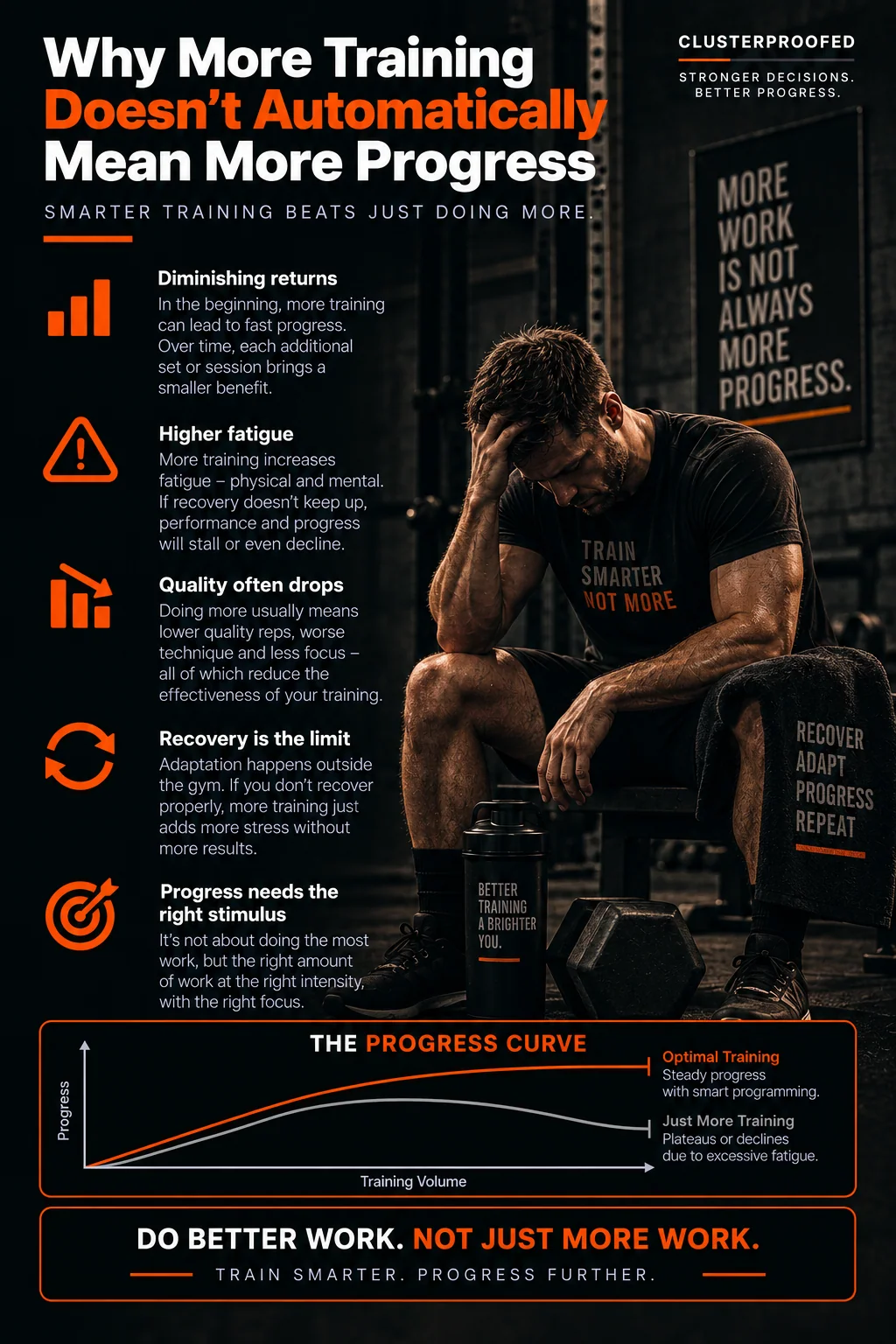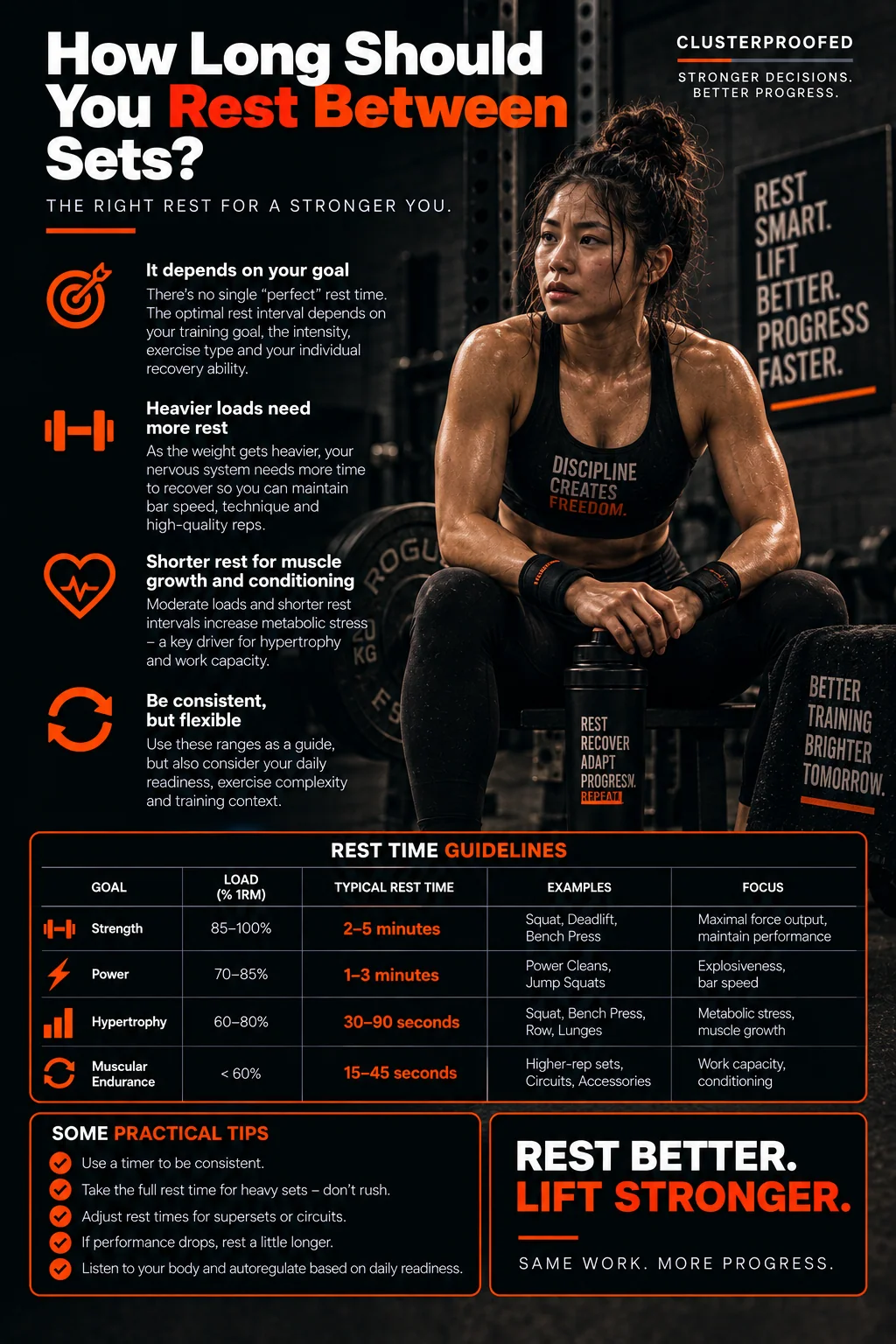
The heavier the weight gets, the smaller the margin for error becomes.
At 60 percent of your 1RM, you can perform several reps in a row without every single rep becoming a maximal effort. At 85 or 90 percent, things look different. Every rep demands a significant portion of your available strength – and fatigue can become noticeable within just a few reps.
This is exactly where the cluster principle gets interesting.
Not because heavy weights suddenly become lighter. But because the conditions under which you move them change.
Heavy Weights Are Sensitive to Fatigue
As a barbell gets heavier, the significance of each individual rep increases.
A rep at 90 percent of your 1RM is no small thing. The necessary force has to be produced even though fatigue may already be present.
In a classic set, this fatigue accumulates rep by rep.
The movement slows down. Technique can change. Perceived effort rises.
That's not inherently bad. Fatigue is part of training.
But it isn't always what we're actually trying to train.
If the goal, for example, is to produce as much high-quality strength work as possible at a heavy load, a large part of the later-set fatigue may simply be a side effect.
This is where the cluster comes in.
A Short Rest Can Change a Lot
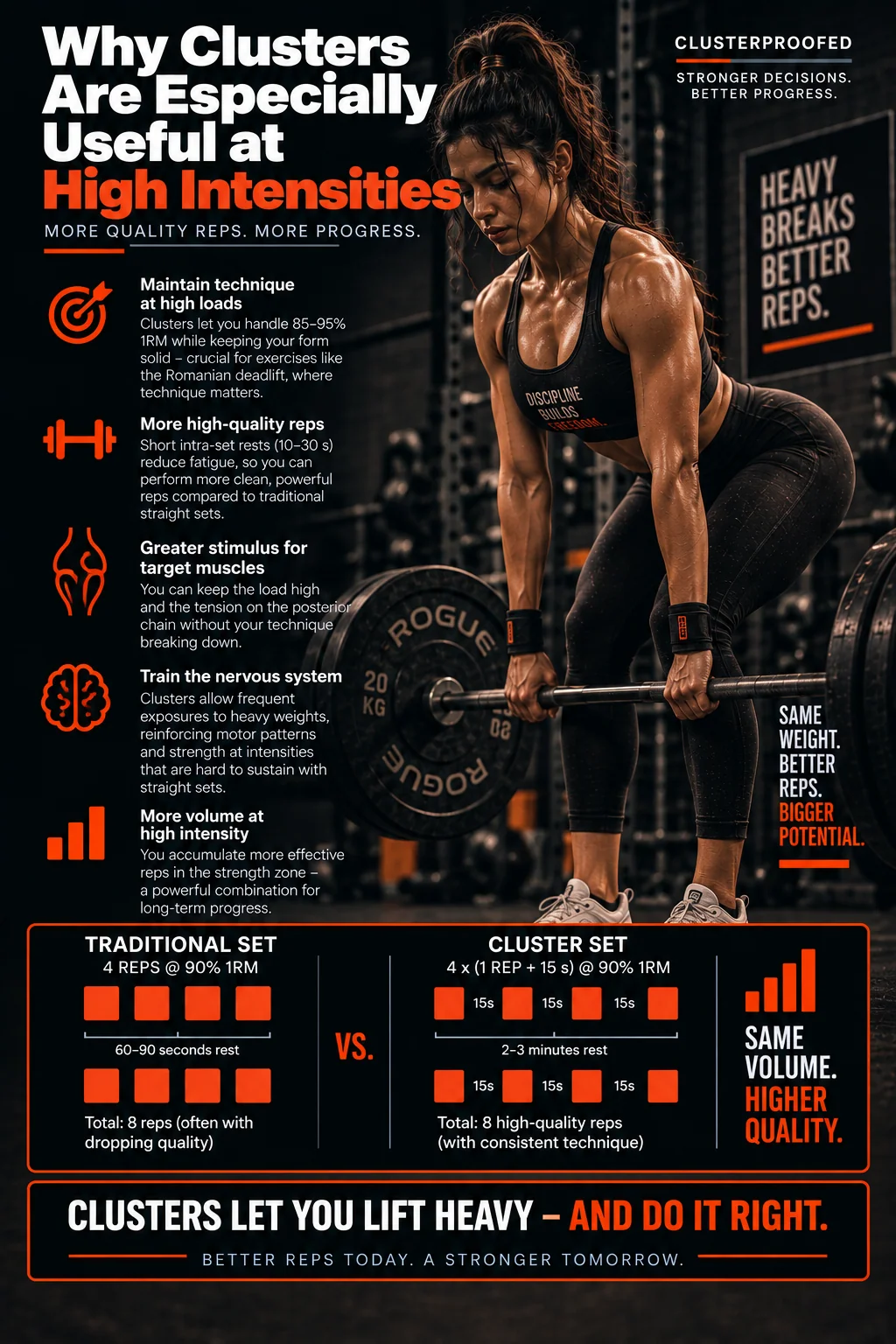
Instead of performing, say, five heavy reps in a row, you could split them up:
2 + 2 + 1
With short rests in between.
The total rep count stays the same. The weight stays the same. But the fatigue is distributed differently.
This small change can make a noticeable difference.
Systematic reviews show that cluster and other alternative set structures can reduce the drop in movement velocity and power output during a training set.
The decisive point isn't that a short rest fully restores the athlete.
It doesn't.
It simply gives them a bit of time to shed part of the acute fatigue.
And at high intensities, that alone can be relevant.
Velocity Is an Interesting Marker
Why does movement velocity matter so much in the first place?
Because it can offer insight into current performance capacity.
If the same load is suddenly moved noticeably slower, that's often a sign that neuromuscular performance is being impaired by fatigue.
That doesn't mean velocity alone determines the quality of a rep. But it's an interesting objective measure, especially when it comes to strength and explosive output.
Clusters make it possible to better preserve this velocity within a set.
Instead of, say, producing five reps where the last one is noticeably slower than the first, a structure like
2 → rest → 2 → rest → 1
can keep the individual reps closer to the athlete's original performance capacity.
Research confirms this effect across various loads and exercises: cluster sets can blunt the loss of velocity, force, and power over the course of a session.
That's particularly interesting when the quality of the movement itself is part of the training goal.
High Intensity Doesn't Automatically Mean High Fatigue
A small conceptual distinction is worth making here.
Intensity and fatigue are not the same thing.
90 percent of your 1RM is a high relative intensity.
How much fatigue that produces depends, among other things, on how many reps are performed, how long the rests are, and how close you get to your individual performance ceiling.
So you can train at high intensity without pushing every single rep to the limit.
This is exactly what makes clusters interesting for heavy strength training.
The load stays high.
The reps stay demanding.
But the fatigue within each rep group becomes more controllable.
This Also Changes Technical Quality
For heavy compound lifts, this isn't just a matter of velocity.
As fatigue rises, the movement itself often changes too.
The squat might get deeper or shallower. The hips might take over more of the work. In the bench press, shoulder-girdle movement can change. In the deadlift, torso position can shift.
Not every technical change is automatically problematic. But the more fatigue increases, the harder it becomes to repeat a movement under the originally intended conditions.
Clusters can offer a real advantage here.
The short rest creates an opportunity to reset the starting position, gather yourself, and execute the next rep again with high focus.
A 2024 randomized crossover study by Páez-Maldonado et al. in 22 moderately trained men (full squat, 3 × 12 at 60% of 1RM) found that the more short rests were built into the set, the better mechanical output was maintained, with lower lactate levels and a smaller decline in jump performance. The load, however, was moderate, not high.
That doesn't mean every exercise necessarily needs to be clustered.
Rather, it means that set structure itself can be a tool for managing fatigue.
This Gets Especially Interesting at 85 to 90 Percent
The closer you get to high relative intensities, the fewer reps are normally possible.
That's one of the reasons cluster structures seem so sensible at heavy loads.
An example:
An athlete works at 90 percent of their 1RM.
A classic set might consist of several reps, with fatigue within the set increasing quickly.
Alternatively, individual reps could be organized with short rests:
1 → rest → 1 → rest → 1 → rest → 1
That looks almost unspectacular.
But that's exactly the point.
The individual rep gets its own space.
The athlete doesn't first have to "survive" a series of reps to reach the next high-quality one.
They can repeatedly produce a single, technically clean, and powerful rep.
That Doesn't Mean Clusters Always Produce More Output
Here it's worth not overinterpreting the scientific literature.
Cluster sets show quite convincing acute effects on velocity, power, and fatigue. That doesn't automatically mean they build more strength or muscle mass than classic sets over the long run.
A 2021 systematic review and meta-analysis by Davies et al. found no fundamental differences between cluster and traditional set structures in terms of strength, power, velocity, or hypertrophy. Both methods can be effective. A possible advantage of the cluster structure lies more in the fact that it can deliver certain training stimuli with less acute fatigue.
A 2026 systematic review and meta-analysis of 25 randomized controlled trials with 573 participants likewise found no overall difference in leg strength. In athletes and in interventions lasting 9–12 weeks, traditional training was partly superior for strength, while cluster training showed a small advantage for explosive power.
That's an important distinction.
Clusters aren't better training. They're a different way of organizing training.
And under certain conditions, that organization can be remarkably useful.
High Intensity and Time-Based Density Training
This brings us to a point that's particularly interesting for time-based training.
If the training time is fixed, the number of reps doesn't necessarily have to be fixed too.
Instead, you can define:
Intensity. Cluster size. Time window. Technical criteria.
Take, for example, 15 minutes at 80 percent of your 1RM with triple clusters.
The athlete works within this time window.
Not every second has to be filled with movement. The rests are necessary to prepare for the next high-quality group of reps.
The task, then, isn't to produce as many reps as possible as quickly as possible.
The task is to gather as much high-quality work as possible within a limited time window.
As intensity rises, cluster size can change accordingly.
Three reps become two.
Two become single reps.
That changes not only the weight.
The entire organization of the work changes.
The Rest Becomes a Training Tool
That's perhaps the most interesting consequence.
In classic training, rest is often treated as a necessary interruption.
In cluster training, it's part of the method.
It determines how much fatigue builds up between reps and how much performance capacity is available for the next group of reps.
A ten- or twenty-second rest is therefore not simply "rest."
It's a variable.
And just like weight or rep count, it can be deployed deliberately.
More rest tends to mean more recovery and thus better conditions for the next rep. Less rest increases fatigue and changes the character of the set.
This opens up a whole spectrum between classic set training and nearly fully isolated singles.
The Real Advantage Lies in Control
Perhaps the point of clusters at high intensities can be summarized most simply like this:
Heavy weights create high demands. Clusters give us more control over how quickly the resulting fatigue affects our performance.
That's not a trick.
Nor is it a way to switch off the body's physiological limits.
Fatigue still arrives.
Just later. Or distributed differently.
As a result, more reps with high technical and mechanical quality can become possible without having to reduce the load.
For some training goals, that's decisive.
Because if the goal isn't to walk away from a set as exhausted as possible, but to gather as much high-quality strength work as possible, then managing fatigue isn't a side issue.
It's part of the training.
And that's exactly where clusters show their particular strength.
Sources & Further Reading
The sources were chosen to match the article's central claims. They are meant to make the factual statements traceable; the strength of the evidence varies by topic.
- Latella, C. et al. (2019), Sports Medicine 49, 1861–1877, "The Acute Neuromuscular Responses to Cluster Set Resistance Training: A Systematic Review and Meta-Analysis." PMC6851217
- Tufano, J. J., Brown, L. E. & Haff, G. G. (2017), Journal of Strength and Conditioning Research 31(3), 848–867, "Theoretical and Practical Aspects of Different Cluster Set Structures: A Systematic Review." DOI: 10.1519/JSC.0000000000001581
- Davies, T. B. et al. (2021), Sports Medicine, "Chronic Effects of Altering Resistance Training Set Configurations Using Cluster Sets: A Systematic Review and Meta-Analysis." DOI: 10.1007/s40279-020-01408-3
- Kong, Z. et al. (2026), BMC Sports Science, Medicine and Rehabilitation 18:127, "Cluster training versus traditional resistance training on lower-limb muscle strength, jumping, and explosive power performance: a systematic review and meta-analysis." DOI: 10.1186/s13102-026-01550-x
- Páez-Maldonado, J. A. et al. (2024), Frontiers in Sports and Active Living, "Cluster sets lead to better performance maintenance and minimize training-induced fatigue than traditional sets." DOI: 10.3389/fspor.2024.1467348
Important: The sources do not automatically support every specific program prescription in Clusterproofed. Time windows, cluster sizes, and percentage-based loads are training-design decisions of the system and should be understood as such.