The question sounds simple:
How long should I rest between my sets?
30 seconds? 60 seconds? 90 seconds? Three minutes?
Or just until you feel ready again?
As so often in strength training, the honest answer is: it depends.
Because the optimal rest period doesn't just depend on whether you want to build muscle or get stronger. Exercise, training intensity, set structure, rep count, and the degree of fatigue all play a role too.
And above all, one idea is worth letting go of:
A rest isn't lost training time. It's part of the training.
Why Do We Need Rest at All?
A lot happens at once during a heavy set.
The working muscles fatigue, energy systems are taxed, and the ability to immediately reproduce the same performance decreases.
You can observe this fairly easily in training.
You do five squats at a weight well suited for five reps.
Right after, you probably couldn't do another five technically clean reps at the same quality.
After three minutes, things look different.
After five minutes, maybe different again.
So rest changes the conditions for the next set.
And that's exactly why it's a training variable.
Short Rest or Long Rest?
The classic recommendation is often:
Muscle building: short rests. Strength: long rests.
It's not quite that simple.
A 2024 systematic review and Bayesian meta-analysis by Singer et al. found an overall small hypertrophy advantage for longer rests compared to very short ones. At the same time, it found no meaningful additional difference above roughly 90 seconds.
That's an important point.
Because it doesn't mean:
"You have to rest three minutes, or your muscle won't grow."
It means, more precisely:
Rests that are too short can more strongly limit performance in the next set.
If you want to do 10 reps, for example, but only manage six in the second set because of a very short rest, the time you saved may have come at a cost.
Why Longer Rests Are Particularly Interesting in Strength Training
This becomes even clearer at heavy loads.
When you train at 85, 90, or 95% of your 1RM, each rep is demanding.
Here, you often want to preserve as much performance as possible.
A systematic review on rest periods and strength development found that trained individuals tend to benefit from rests longer than two minutes when the goal is maximal strength development.
That's understandable.
If you've just completed a heavy set of squats, deadlifts, or bench presses, forcing yourself back under the bar after 30 seconds does little good if the next set suffers noticeably as a result.
The rest, in that case, serves to preserve performance.
But Does That Mean Longer Rests Are Always Better?
No.
Because even a five-minute rest has a cost.
It extends the session.
And if the additional recovery no longer provides a meaningful additional benefit, sensible recovery eventually just becomes waiting time.
This becomes especially interesting when you view training not in isolation, but as an overall system.
Take three sets of an exercise, for example.
With three minutes of rest, the session takes noticeably longer than with 60 seconds.
If the longer rest genuinely lets you produce more high-quality work, it can be worthwhile.
But if you're already sufficiently ready to perform after 60 seconds, another two minutes isn't automatically more productive.
The optimal rest, then, isn't a magic number.
It's wherever recovery and training economy line up sensibly.
The Exercise Makes a Difference
Not every exercise produces the same fatigue.
Five heavy squats are something different from 15 bicep curls.
A heavy set of deadlifts involves large muscle groups and produces a high systemic load.
A set of lateral raises is on a different scale entirely.
That's why a blanket recommendation like "always rest two minutes" wouldn't be particularly useful.
For heavy compound lifts, longer rests can be sensible.
For smaller isolation exercises, shorter rests can be entirely sufficient.
And in some training methods, the rest is even a deliberate part of the exercise structure itself.
The Rest Determines What the Next Set Can Deliver
This is perhaps the most important perspective.
The question shouldn't only be:
"How long do I have to wait?"
But:
"What is the next set supposed to accomplish?"
If the next set is supposed to be as heavy and technically clean as possible, you probably need more recovery.
If you deliberately want to create high training density, a shorter rest can make sense.
If you performed a set close to failure, you probably need longer than after a set with a clear margin from failure.
The rest, then, is always tied to the task.
And This Is Exactly Where Clusters Become Interesting
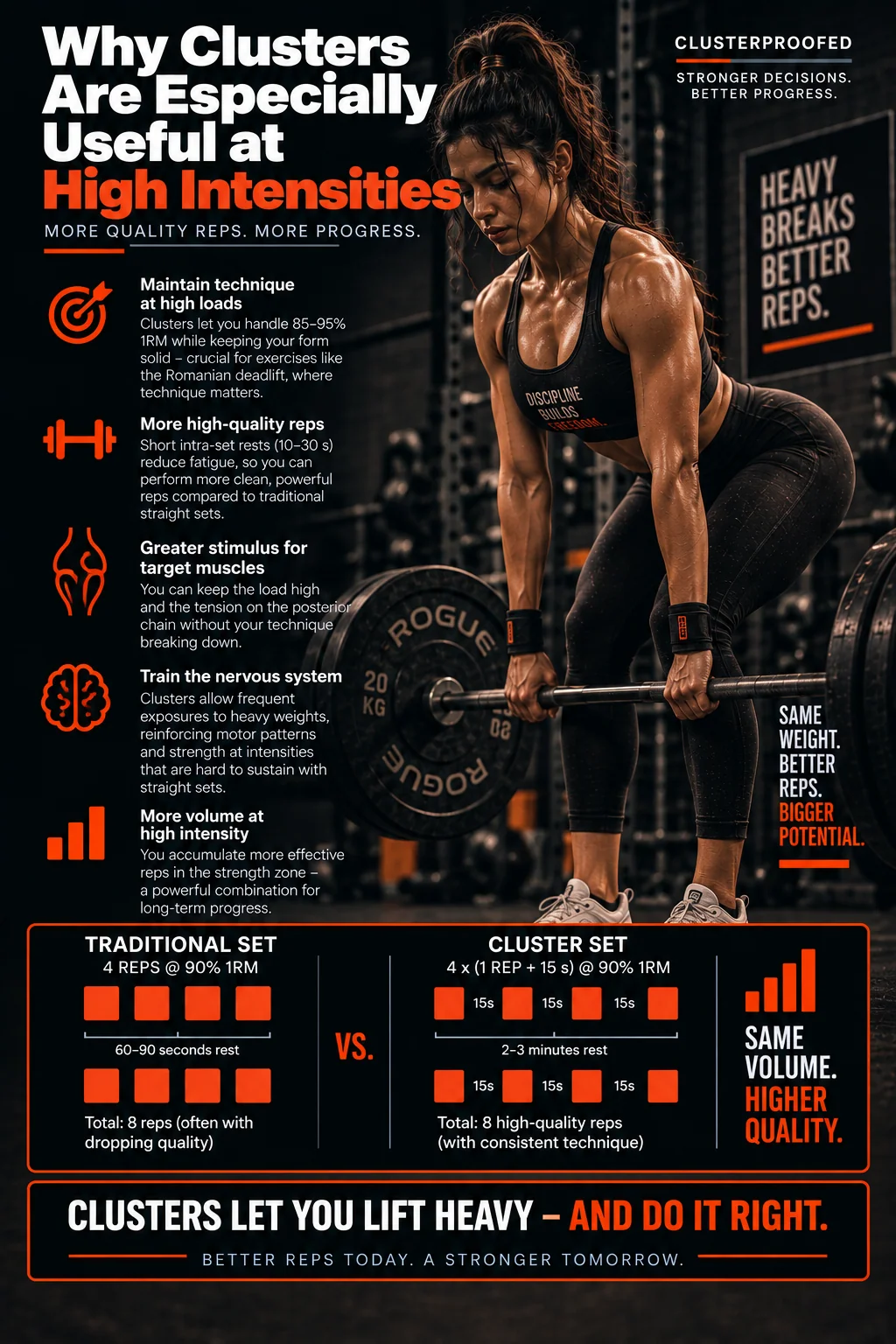
A classic set might look like this, for example:
6 reps
Cluster training changes the organization:
2 + 2 + 2
With short rests in between.
The total volume doesn't have to change because of this.
But the fatigue within the set is distributed differently.
This is a good example of the fact that "rest" isn't simply a binary state – either you're training or you're resting.
The structure of the rest can itself be part of the training method.
That's particularly interesting at high intensities, because it can help preserve performance and technical quality across several reps.
So How Long Should You Rest?
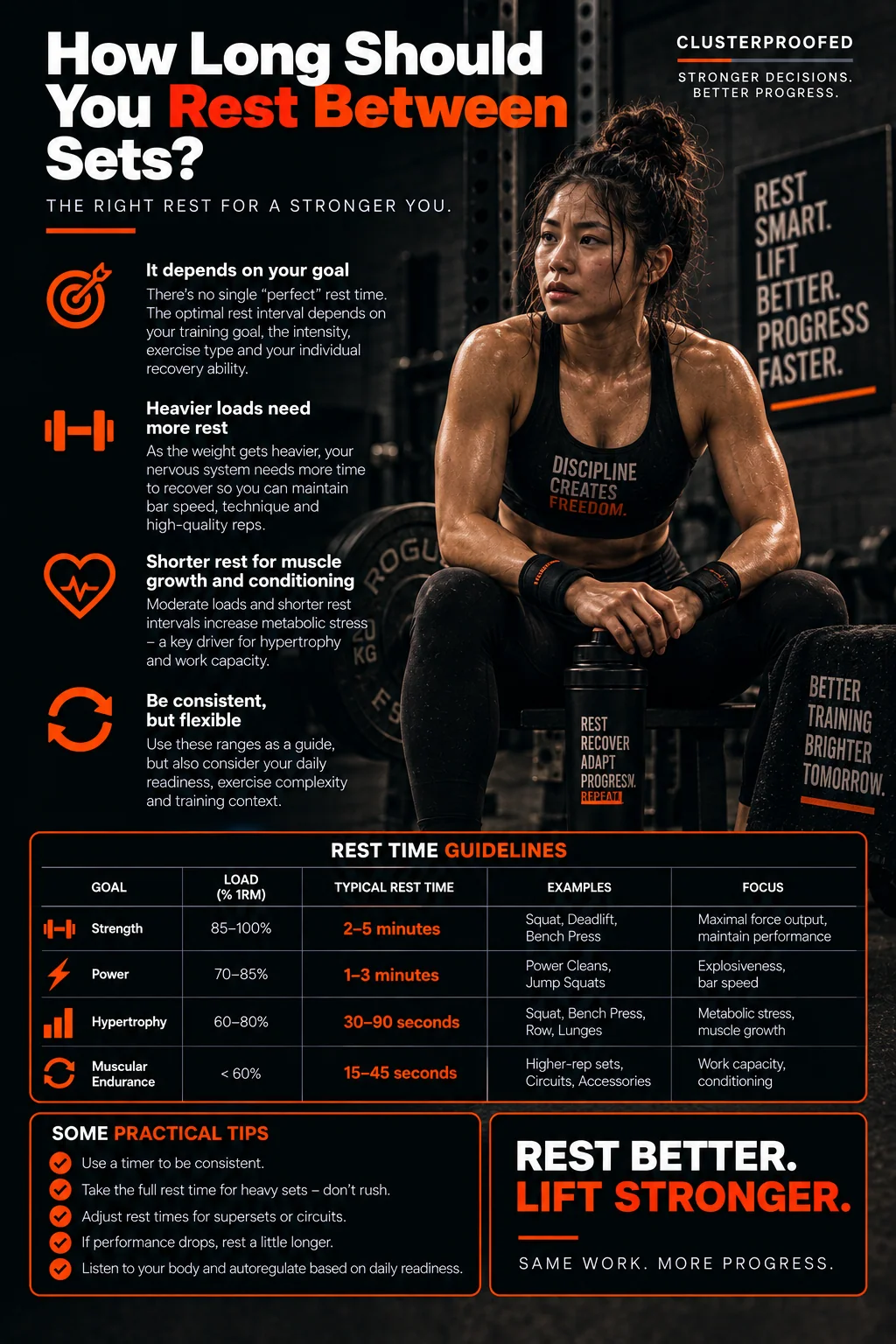
A practical guideline might look like this:
For heavy strength training
For heavy compound lifts and low rep counts, 2–5 minutes is often sensible.
Especially when the quality of the next set is decisive.
For hypertrophy training
About 1–3 minutes is a reasonable starting point for many exercises.
For very demanding compound lifts, it can be longer.
For smaller exercises
60–120 seconds is often enough.
For very light exercises, even shorter rests can work.
For high training density
Here it gets interesting.
If density itself is part of the training goal, rest is deliberately limited.
The point then isn't to be fully fresh after every set.
It's about producing performance within a defined fatigue window.
The Clock Shouldn't Work Against You
An interesting consequence of all this:
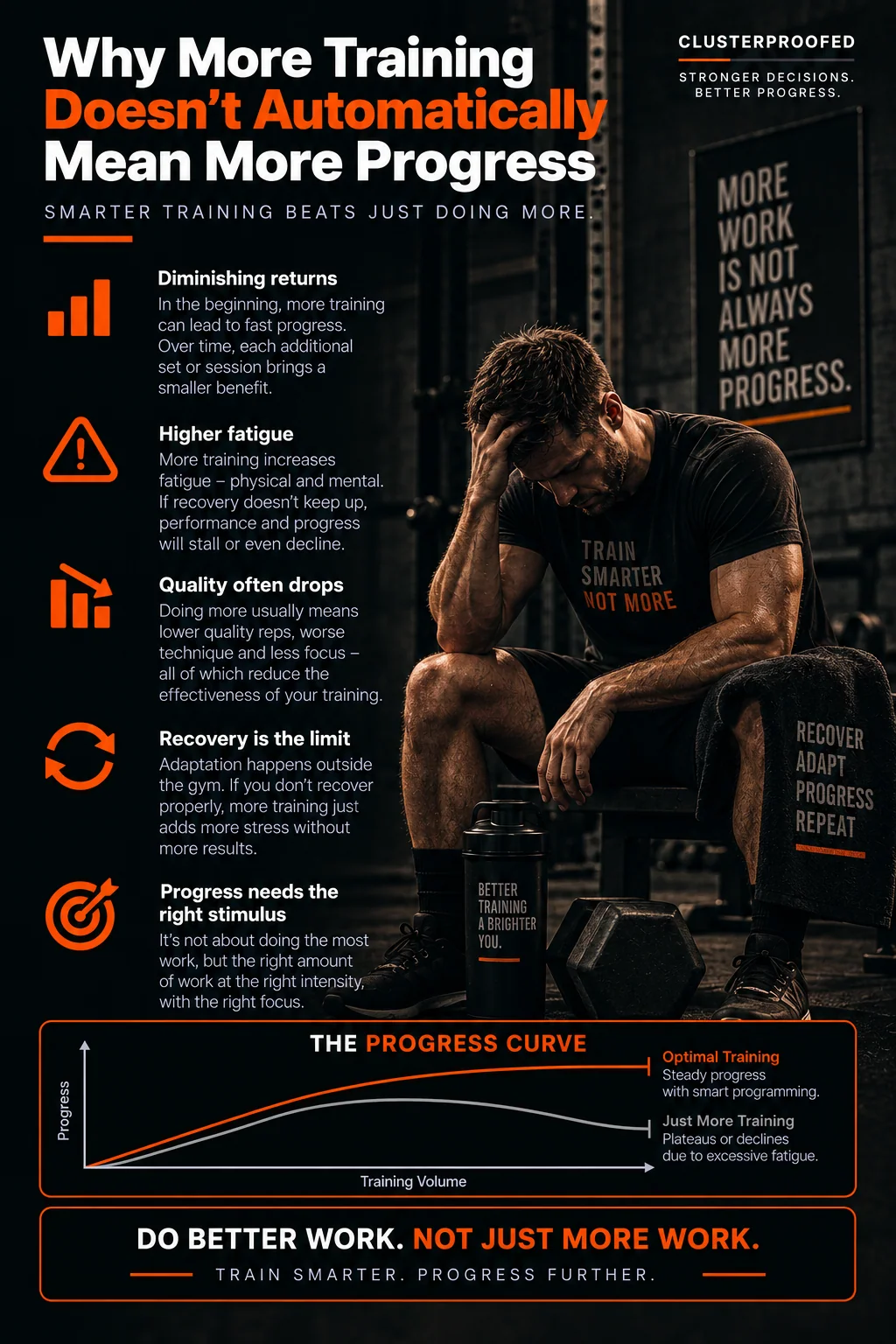
You shouldn't make the rest unnecessarily short or unnecessarily long.
A rest that's too short can unnecessarily limit the next performance.
A rest that's too long can cost time without delivering a corresponding additional benefit.
The best rest, then, isn't:
"as short as possible"
and it isn't:
"as long as possible"
either.
It's rather:
as long as necessary, as short as sensible.
That sounds unspectacular.
But it's actually a pretty good description of intelligent training.
What Does This Mean for Density8?
With a time-based training approach, the question shifts once more.
Because there, time isn't just the interruption between two sets.
It's part of the training frame.
A 12- or 15-minute window defines how long the work lasts. Within that frame, the combination of intensity, cluster size, and rest determines how much high-quality performance actually results.
So the rest isn't simply eliminated.
It's organized.
And that's exactly where an interesting difference from the classic "set – rest – set" model lies.
The question is no longer only:
"How long should I wait between my sets?"
But:
"How much recovery does the next high-quality rep need – and how much of that do I have available within my time window?"
That's a somewhat different way of looking at training.
And maybe that's the most sensible answer to the original question:
Rest isn't a necessary evil between sets.
It helps determine what the next set can actually deliver.
Sources & Further Reading
The sources were chosen to match the article's central claims. They are meant to make the factual statements traceable; the strength of the evidence varies by topic.
- Grgic, J., Schoenfeld, B. J., Skrepnik, M., Davies, T. B. & Mikulic, P. (2018), Sports Medicine 48(1), 137–151, "Effects of Rest Interval Duration in Resistance Training on Measures of Muscular Strength: A Systematic Review." DOI: 10.1007/s40279-017-0788-x
- Grgic, J. et al. (2017), European Journal of Sport Science 17(8), "The effects of short versus long inter-set rest intervals in resistance training on measures of muscle hypertrophy: A systematic review." DOI: 10.1080/17461391.2017.1340524
- Singer, A., Wolf, M., Generoso, L., Arias, E., Delcastillo, K., Echevarria, E., Martinez, A., Androulakis Korakakis, P., Refalo, M. C., Swinton, P. A. & Schoenfeld, B. J. (2024), Frontiers in Sports and Active Living, "Give it a rest: a systematic review with Bayesian meta-analysis on the effect of inter-set rest interval duration on muscle hypertrophy." DOI: 10.3389/fspor.2024.1429789
Important: The sources do not automatically support every specific program prescription in Clusterproofed. Time windows, cluster sizes, and percentage-based loads are training-design decisions of the system and should be understood as such.