There's a fairly simple idea that persists stubbornly in strength training:
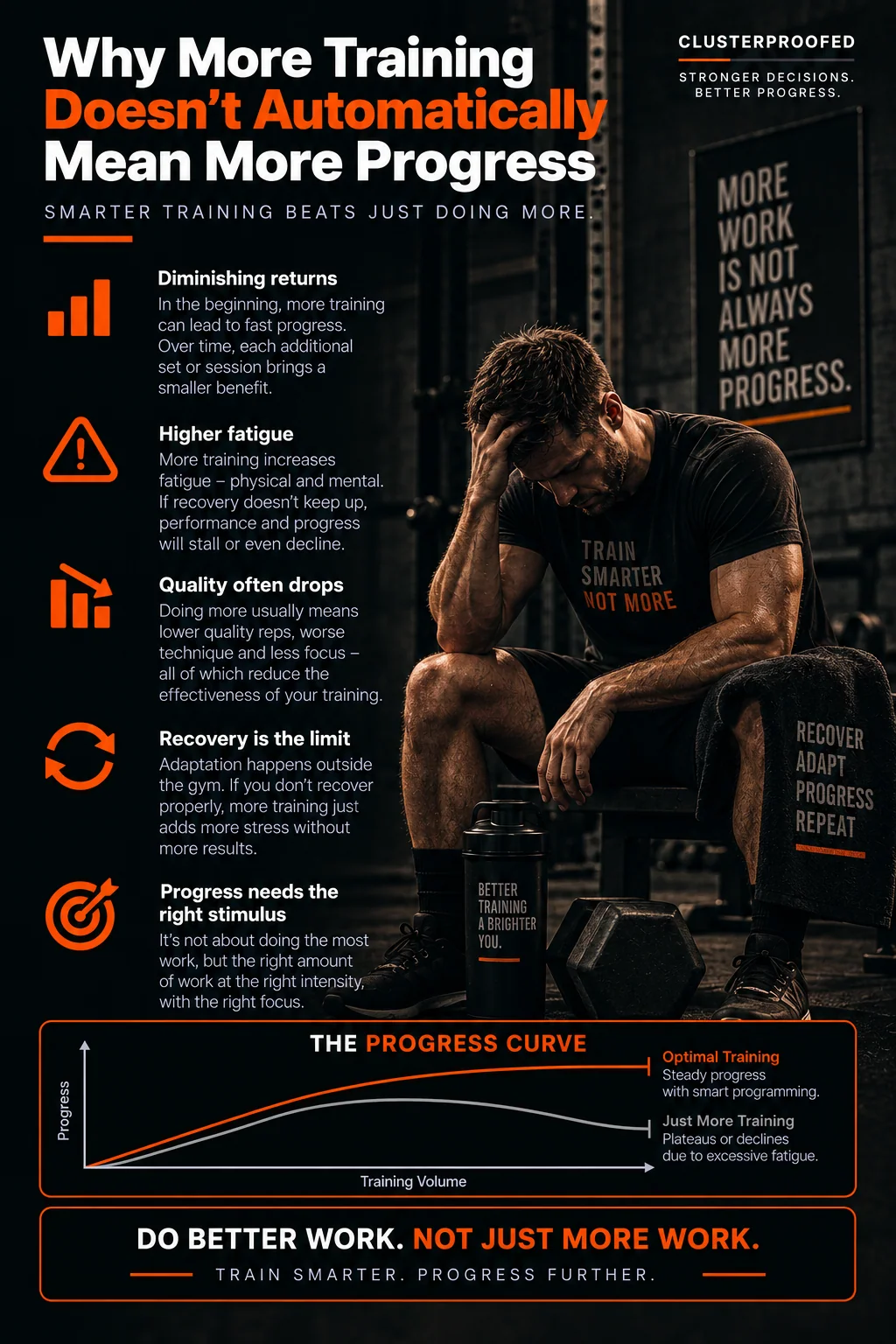
If training is good, more training must be even better.
More sets. More reps. More weight. More intensity. More soreness. More exhaustion.
Sounds logical at first.
After all, training sets a stimulus that the body adapts to. So why not set as many stimuli as possible?
The problem is: the body doesn't just respond to the training stimulus.
It also has to process the load.
And that's exactly where the interesting side of strength training begins.
Training Doesn't Just Produce a Stimulus
Every demanding training session produces at least two things at once:
a training stimulus
and
fatigue.
The training stimulus gives the body a reason to adapt.
Fatigue is the price paid for that.
The two belong together.
Train hard, and you get tired. Increase volume, and you create additional load. Train closer to failure more often, and you can produce a stronger acute fatigue effect. And the higher certain load factors climb, the more performance and subjective recovery after a session can be impaired.
That doesn't mean fatigue is bad.
It's a normal part of training.
But it isn't a quality marker in itself, either.
A session after which you can barely get down the stairs wasn't automatically better than one after which you still feel pretty good.
Muscle Soreness Is Not a Training Log
That sounds obvious, but it gets confused surprisingly often in everyday practice.
"I'm completely wrecked."
"I could barely walk for three days afterward."
"My muscles were on fire."
Those are descriptions of load and fatigue.
By themselves, they don't yet say how good the training actually was.
Because the body is supposed to adapt to training in the long run. To do that, it doesn't just have to survive the load – it has to process it and translate it into a long-term improvement in performance.
And that's exactly why this question:
How much training produces a meaningful additional stimulus – and at what point does it mostly just produce additional fatigue?
is far more interesting than:
How much training can I somehow endure?
More Volume Can Be Sensible
That doesn't mean more training is fundamentally bad.
Quite the opposite.
More sensible training volume can lead to additional adaptations. Volume plays an especially important role for hypertrophy.
But the relationship isn't arbitrary.
An extra set isn't automatically as valuable as the one before it.
Picture this situation:
The first three sets of an exercise deliver a strong training stimulus.
A fourth set can still be worthwhile.
Maybe a fifth as well.
But at some point, the ratio shifts.
The additional set still costs time, energy, and recovery – while its added benefit may keep shrinking.
That doesn't mean you could pinpoint an exact moment when "too much" suddenly begins.
The human body doesn't work that way.
But there's an important practical principle:
More training work doesn't automatically mean more training adaptation.
The Most Expensive Part of Training Isn't Always the Most Productive
This becomes especially interesting with training to muscular failure.
Failure training isn't fundamentally bad. It can absolutely be a useful training tool.
But it's also not necessary to push every set all the way to the end.
For strength, meta-analyses find no clear advantage; for hypertrophy, the evidence is less clear, and proximity to failure may play a role.
At the same time, training to failure can increase acute fatigue. That matters because the additional fatigue can't be considered in isolation.
It can affect:
- performance in subsequent sets,
- the quality of further reps,
- recovery after the session,
- performance capacity in the next training session.
This creates an interesting paradox:
A rep can become more strenuous without becoming proportionally more valuable.
That's one reason "more" and "harder" are two different things.
The Last Inch Isn't Always the Most Important
Take a set of ten reps.
The first reps are technically clean.
Velocity is controlled.
The movement looks stable.
Rep eight gets slow.
Rep nine gets even slower.
Rep ten is just barely possible.
And then rep eleven follows.
Technique changes noticeably. The movement turns into a struggle. Maybe it still succeeds.
Was that eleventh rep automatically especially valuable because it was the hardest?
No.
Above all, it was expensive.
Maybe it was worthwhile.
Maybe it wasn't.
That's exactly why training quality shouldn't be measured solely by the subjective difficulty of a rep.
A rep can be extremely strenuous and still deliver relatively little additional benefit.
The Relationship Between Stimulus and Fatigue
In training science, this is often discussed as the relationship between stimulus and fatigue.
That's not an exact mathematical formula.
It's more of a useful mental model.
A session might look like this, for example:
high stimulus + moderate fatigue
That's interesting.
Or:
high stimulus + very high fatigue
That can also be worthwhile – but maybe not every day.
More problematic is:
low additional stimulus + very high additional fatigue
Because then you're paying a relatively high price for a relatively small additional benefit.
The goal of a good training program, then, isn't to avoid fatigue entirely.
That would be impossible.
The goal is to dose fatigue sensibly.
And This Is Where Training Density Comes In
This connects directly to our previous article on training density.
Because the time in which training work happens also influences the structure of fatigue.
Take 20 reps again.
You can spread them over 30 minutes.
Or over 15 minutes.
Or over eight minutes.
The volume stays the same.
But the load is organized differently.
At high density, the next rep follows faster. Rests get shorter or are distributed differently. Fatigue can accumulate more within the time window.
That's why high density isn't automatically better.
It's a control mechanism.
And that's exactly the interesting point:
A good training system doesn't try to produce as much fatigue as possible. It tries to deploy the available fatigue as sensibly as possible.
Quality Becomes More Important as Load Rises
This is especially true for heavy strength training.
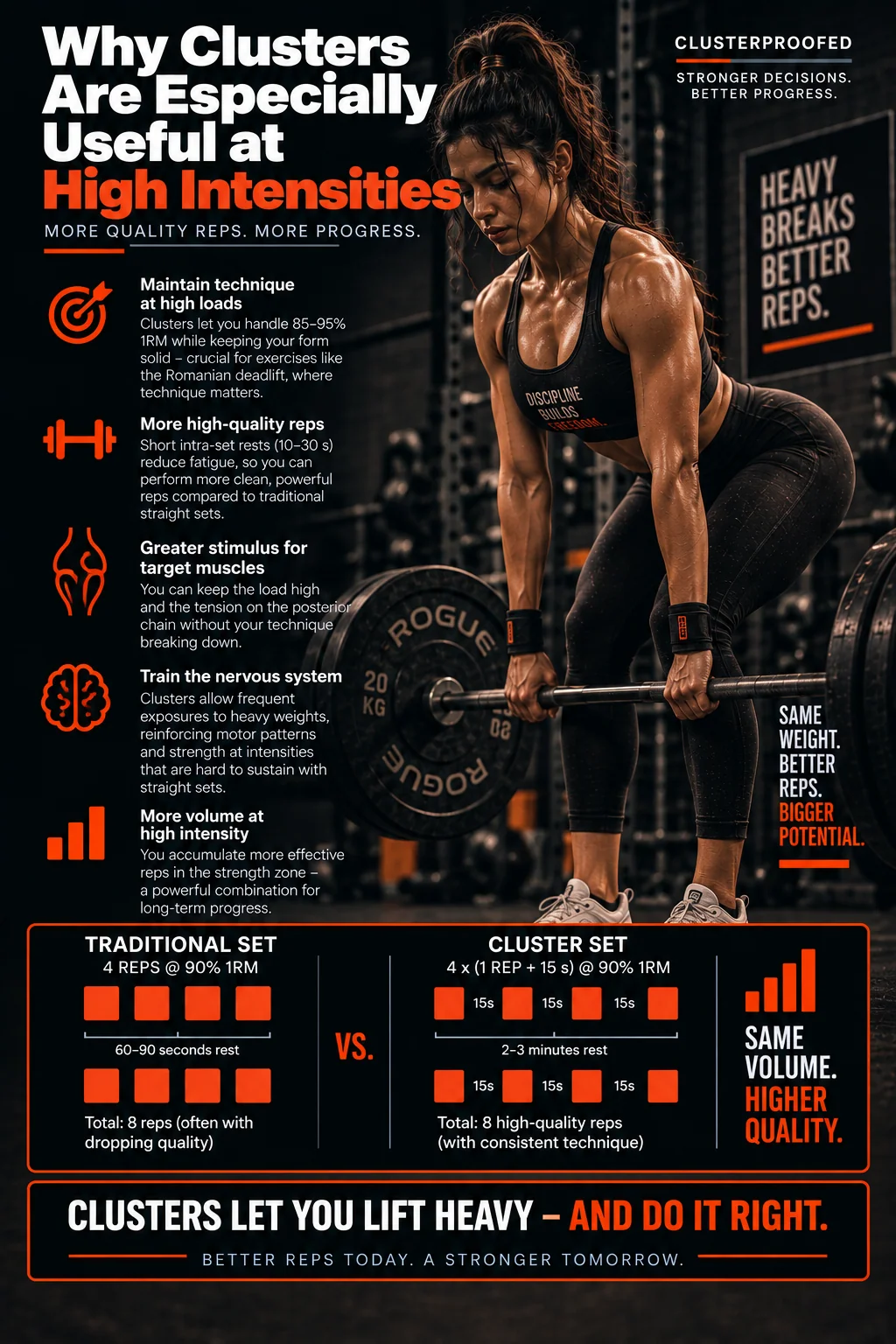
When you train at 60% of your 1RM, you can complete a fair amount of work before any single rep becomes technically problematic.
At 90%, things look different.
Here, every rep becomes more consequential.
A poor rep isn't simply one more rep.
It can worsen technique, reduce movement velocity, and generate additional fatigue.
That's exactly why cluster structures are interesting.
Instead of performing, say, six heavy reps without interruption, you can break them into smaller groups.
2 + 2 + 2
or
1 + 1 + 1 + 1 + 1 + 1
The total volume doesn't have to change because of this.
But the fatigue within the individual reps can be distributed differently.
The goal isn't to train less.
It's about preserving more of the desired performance under controllable conditions.
Good Training Sessions Don't Have to Leave Devastation Behind
This is perhaps one of the most important ideas of all.
A good session is allowed to be demanding.
It's allowed to be hard.
It's allowed to challenge you.
But it doesn't have to destroy you.
Because your training doesn't end with the last rep.
After that comes the phase in which your body processes the load.
And the next training day begins the next chapter.
If a session is so exhausting that the next two or three sessions suffer because of it, you have to evaluate the quality of that original session differently.
Not in isolation.
But in the context of the entire training process.
A single heroic training session is less interesting than many good sessions in a row.
That's probably one of the most important long-term differences between training and simply pushing yourself to exhaustion.
Progress Happens Over Weeks, Not Within a Single Session
Strength training is a long-term process.
The decisive question, then, isn't:
"How much can I squeeze out of myself today?"
But:
"What performance can I reliably reproduce and increase over weeks and months?"
That shifts the perspective.
If you manage five percent more volume today, but the next two sessions suffer noticeably because of it, that may not have been progress at all.
If, on the other hand, you maintain the same training quality over several weeks and slowly achieve more weight, more reps, or more performance within a defined time window, things look different.
Progress isn't always spectacular.
Sometimes it simply looks like this:
Same time. Same weight. More clean reps.
Or:
Same performance. Less fatigue.
Or:
Higher weight. Same technical quality.
These are far more interesting changes than the question of whether you were completely wiped out after training.
The Art Lies in Doing Enough
Perhaps the whole topic can be reduced to a single sentence:
The goal isn't to complete as much training as possible. The goal is to complete enough training for adaptation to happen – without producing unnecessary amounts of fatigue.
That sounds less spectacular at first.
But it's probably closer to what long-term training actually comes down to.
More is sometimes better.
More is sometimes necessary.
And sometimes, more is just more.
The decisive skill lies in recognizing the difference.
What This Means for Time-Based Training
A fixed time window can offer an interesting solution here.
Not because ten, twelve, or 15 minutes are magic numbers.
But because a time window creates a clear frame.
Within that frame, there's no attempt to force as many reps as possible at any cost.
Instead, what counts is the performance that can actually be produced under the given conditions.
That changes the question from:
"How much more can I do?"
to:
"How much high-quality work can I produce within this frame?"
And that's a fairly significant difference.
Because at some point, training stops being about convincing the body that it can suffer.
It already knows that.
It's about giving it a sufficient reason to get better.
And that's exactly where good training begins.
Not at maximum fatigue. But at maximally sensible work.
Sources & Further Reading
The sources were chosen to match the article's central claims. They are meant to make the factual statements traceable; the strength of the evidence varies by topic.
- Schoenfeld, B. J., Ogborn, D. & Krieger, J. W. (2017), Journal of Sports Sciences 35(11), 1073–1082, "Dose-response relationship between weekly resistance training volume and increases in muscle mass: A systematic review and meta-analysis." DOI: 10.1080/02640414.2016.1210197
- Grgic, J. et al. (2022), Journal of Sport and Health Science, "Effects of resistance training performed to repetition failure or non-failure on muscular strength and hypertrophy: A systematic review and meta-analysis." DOI: 10.1016/j.jshs.2021.01.007
- Robinson, Z. P. et al. (2024), Sports Medicine, "Exploring the Dose-Response Relationship Between Estimated Resistance Training Proximity to Failure, Strength Gain, and Muscle Hypertrophy: A Series of Meta-Regressions." DOI: 10.1007/s40279-024-02069-2
Important: The sources do not automatically support every specific program prescription in Clusterproofed. Time windows, cluster sizes, and percentage-based loads are training-design decisions of the system and should be understood as such.